


Safe Tanker Access: Choosing the Right Platform for Loading and Maintenance
Working around tanker trucks often requires operators to access elevated hatches, valves, fittings, hoses and other equipment. Without the right access equipment, these tasks can expose workers to unnecessary risks, particularly when they involve climbing onto or around the top of a tanker.
Safe Tanker Access starts with choosing an access system that is designed for the actual working environment. A purpose-built platform can provide a stable working area, controlled access and fall protection while helping businesses establish a more consistent approach to tanker loading, inspection and maintenance.
For Australian workplaces, working at height is an important workplace health and safety consideration. Safe Work Australia states that businesses must, so far as is reasonably practicable, eliminate or minimise risks associated with working at height and provide safe ways to enter and exit areas where there is a risk of falling. Where work cannot be performed at ground level, appropriate fall-prevention measures should be considered.
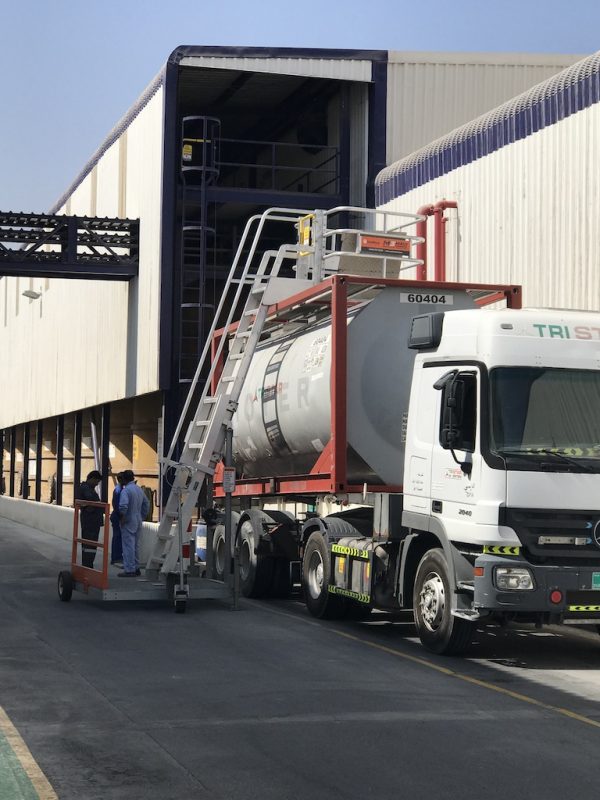
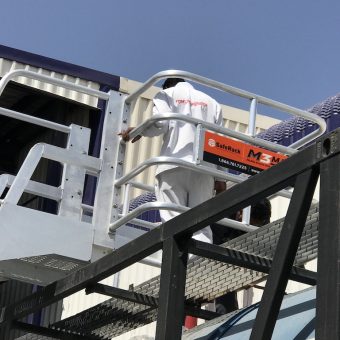
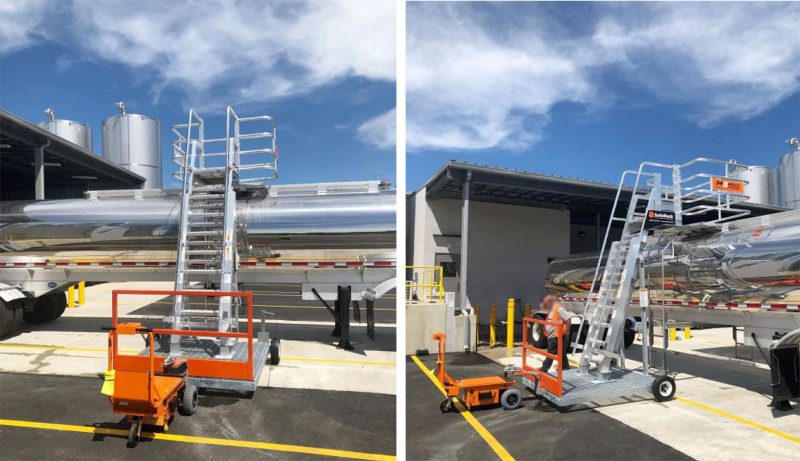
For tanker loading and maintenance applications, the SafeRack MAUI 12/16 Mobile Loading Platform provides a purpose-built approach to elevated access. With an adjustable working height from approximately 3658 mm to 4877 mm, it is designed to provide mobile access to tankers, railcars and other elevated work areas.
Why Safe Tanker Access Matters
Tankers are designed to transport liquids and other materials efficiently, but their height and configuration can make routine access challenging.
Workers may need to reach the top of a tanker to perform tasks such as:
- Opening or closing access hatches
- Connecting or disconnecting hoses
- Sampling materials
- Inspecting equipment
- Checking valves and fittings
- Performing cleaning tasks
- Carrying out maintenance
- Conducting loading or unloading procedures
Each task can involve a combination of height, vehicle movement, slippery surfaces, weather conditions and other workplace hazards.
WorkSafe Queensland identifies falls from trucks and trailers as a significant transport-industry risk. Its guidance recommends considering engineering controls such as mobile work platforms, edge protection and suitable access equipment to reduce the need for workers to climb onto vehicles.
This is why tanker access should not be treated simply as a matter of finding a ladder tall enough to reach the required height.
The access solution should be considered as part of the overall work system.
The Limitations of Temporary Ladders
A portable ladder can be useful for many short-duration tasks, but tanker access presents additional challenges.
A conventional ladder generally provides a narrow climbing surface rather than a dedicated working area. Once a worker reaches the required height, they may still need to perform tasks while maintaining their balance, handling hoses or tools, or working around tanker fittings.
This can make the task more difficult and potentially increase exposure to falls.
WorkSafe Queensland specifically identifies poorly designed ladders and steps, climbing onto trucks and trailers, unprotected openings and unsuitable access arrangements among the factors associated with falls from trucks and trailers.
For businesses where tanker access is performed regularly, the question should therefore be:
Can the task be redesigned so workers can access the required area from a stable, purpose-built platform?
Where ground-level access is not possible, an engineered access system may provide a more appropriate control.
What to Look for in a Safe Tanker Access Platform
Choosing the right tanker access platform requires more than checking its maximum height.
Several factors should be considered.
1. Working Height
Tankers are not all the same height. Different vehicle designs, access points and operating environments can require different platform heights.
An adjustable platform can provide greater flexibility than a fixed-height ladder or access structure.
The SafeRack MAUI 12/16 has a working height range of approximately 3658 mm to 4877 mm, making it suitable for a variety of elevated access applications.
The MAUI range also includes the MAUI 10/14, which provides a lower working-height range of approximately 3038 mm to 4267 mm.
The appropriate model should therefore be selected according to the actual tanker dimensions, access point and task requirements.
2. Stability
A tanker access platform needs to provide a stable working area without depending on improvised positioning.
The MAUI 12/16 is designed as a self-supporting mobile platform. Spacepac states that it can support up to 227 kg without resting on the vehicle being accessed.
This is important because a dedicated platform allows the access system and the tanker to remain separate structures.
Rather than relying on the tanker for support, the platform is positioned to provide a controlled access point.
3. Fall Protection
Simply providing access to the top of a tanker does not automatically make the task safe.
The working area also needs to address the risk of a person falling from an elevated position.
Depending on the configuration and application, the MAUI system can incorporate fall-protection cage options. This can create a more controlled working area around the elevated access point.
Fall protection should always be considered as part of the overall risk assessment and selected according to the specific task, equipment configuration and applicable workplace requirements.
4. Mobility
Tanker fleets and loading areas can involve multiple vehicle positions.
A permanently installed access structure may not be practical where different tanker bays, loading points or work areas need to be accessed.
A mobile platform provides the ability to position the access equipment where it is required.
SafeRack’s MAUI is designed as a mobile access system for applications involving tank trucks, railcars and other elevated work areas. SafeRack describes the MAUI as a rolling platform that can be used where access for inspection or venting is required at varying locations within a plant.
This mobility can make the platform useful across multiple operational areas rather than limiting it to one fixed location.
MAUI 12/16: A Purpose-Built Solution for Safe Tanker Access
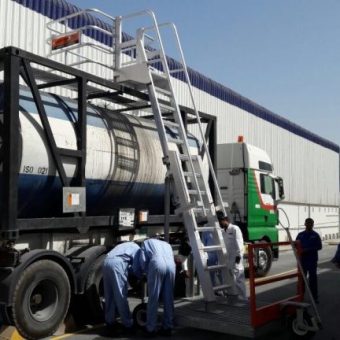
The SafeRack MAUI 12/16 Mobile Loading Platform is the key SafeRack solution to consider when elevated tanker access is a recurring requirement.
Its adjustable height range of approximately 3658 mm to 4877 mm provides access for taller vehicles and elevated work areas. It can also be used for applications involving railcars and other elevated equipment.
The platform is designed around several practical requirements for elevated access:
- Adjustable working height
- Mobile positioning
- Self-supporting construction
- 227 kg capacity
- Fall-protection options
- Access for tanker trucks and railcars
- Applications involving inspection, loading and maintenance
The combination of these features makes the MAUI 12/16 more than simply a taller ladder.
It provides a dedicated work area designed around the requirements of elevated industrial access.
Applications for Safe Tanker Access
Safe tanker access can be required across a wide range of industries.
Transport and Logistics
Transport operators may need regular access to tanker vehicles for inspections, loading, unloading and maintenance.
A mobile access platform can help create a repeatable procedure for accessing elevated areas rather than relying on different temporary access methods.
Chemical and Petrochemical Operations
Chemical facilities may use tankers for transporting bulk liquids and other materials.
Tasks may include:
- Hose connections
- Valve inspection
- Sampling
- Hatch access
- Loading operations
- Equipment maintenance
Because these activities can involve both working at height and potentially hazardous materials, access arrangements should form part of the site’s overall risk-management process.
Food and Beverage
Bulk liquid tankers are commonly used throughout food and beverage supply chains.
Workers may need to inspect, clean or access tanker equipment during receiving and loading procedures.
A dedicated access platform can help provide a controlled access point while supporting consistent operating procedures.
Mining and Resources
Mining and resource operations often involve large vehicles, tankers and elevated processing equipment.
Access requirements can include inspection, servicing and maintenance.
A mobile platform can provide greater flexibility where multiple vehicles or work areas need to be serviced.
Waste Management
Waste and liquid-waste operations can also involve elevated tanker access.
Regular inspections and maintenance can require workers to reach elevated areas while working around large vehicles and busy operating environments.
A purpose-built access platform can help separate the access task from surrounding vehicle movements when incorporated into an appropriate site safety system.
Safe Tanker Access for Loading Operations
Loading and unloading activities deserve particular attention because workers may be interacting with vehicles, hoses, pumps, valves and other equipment at the same time.
WorkSafe Queensland recommends considering ways to eliminate the need for workers to climb onto trucks and trailers where practicable. Its guidance also identifies mobile work platforms and edge protection as potential engineering controls.
A tanker access platform can therefore form part of a broader loading system.
The objective should not simply be to give workers a way to reach the tanker.
Instead, the access arrangement should be designed around the complete task:
Position the tanker → establish the exclusion zone → position the access equipment → secure and inspect the platform → access the required work area → complete the task → exit safely → remove the access equipment when appropriate.
The exact procedure will depend on the facility, tanker configuration, loading system and risk assessment.
Safe Tanker Access for Inspection and Maintenance
Tanker access is not limited to loading and unloading.
Maintenance teams may also require elevated access for inspections, repairs and servicing.
Examples include:
- Inspecting hatches and covers
- Checking valves and fittings
- Examining hoses and connections
- Cleaning equipment
- Inspecting tanker components
- Performing routine maintenance
A stable platform can make these tasks easier to plan because workers have a defined access route and working area.
This is particularly relevant where tasks are performed regularly.
Instead of creating a new access arrangement for every maintenance activity, businesses can establish a consistent system around purpose-built equipment.
Platform Selection: MAUI 12/16 or MAUI 10/14?
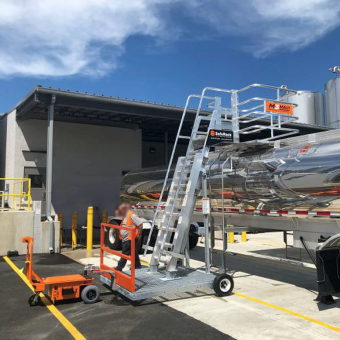
The SafeRack MAUI range includes different configurations and height ranges, so the correct model should be determined by the application.
The MAUI 12/16 provides a working height of approximately 3658 mm to 4877 mm, making it suited to taller tanker and elevated access requirements.
The MAUI 10/14 provides a working height of approximately 3038 mm to 4267 mm and may be more appropriate for lower access requirements.
When selecting between them, consider:
- Tanker height
- Access point height
- Required working position
- Frequency of use
- Available floor space
- Platform mobility requirements
- Required fall-protection configuration
- Other vehicles or equipment that may need access
- Site-specific risk controls
The tallest platform is not necessarily the right platform. The objective is to select equipment that provides the required access while fitting the actual operating environment.
When a Gangway May Be More Appropriate
Not every tanker application requires a mobile platform. The right Safe Tanker Access solution depends on how the vehicle is positioned and how the work is performed.
In some loading environments, a gangway may provide a more suitable connection between a fixed platform and the vehicle.
SafeRack gangways and loading ramps are available in multiple widths, materials and configurations. Spacepac’s SafeRack range includes solutions designed around vehicle loading and elevated access applications, helping businesses establish reliable Safe Tanker Access for their specific loading environment.
The choice between a mobile platform and a gangway depends on the site’s layout, vehicle positioning, access requirements and loading process. Considering these factors is essential when planning Safe Tanker Access.
For facilities with fixed loading stations, a permanent or semi-permanent access system may make sense.
For operations where tankers arrive at different locations or access points vary, a mobile system such as the MAUI may provide greater flexibility.
Creating a Safer Tanker Access Procedure
Selecting the right equipment is only one part of safe tanker access.
Businesses should also establish clear procedures for its use.
A practical procedure may include:
Assess the Work Area
Before positioning the platform, inspect the ground and surrounding area.
Look for:
- Uneven surfaces
- Obstructions
- Spills
- Debris
- Vehicle traffic
- Other mobile plant
- Overhead hazards
- Weather conditions
WorkSafe Queensland recommends that loading and unloading areas be inspected and prepared, with attention to debris, holes, obstructions and slip or trip hazards.
Control Vehicle and Pedestrian Movement
Tanker loading areas can involve vehicles, mobile plant and pedestrians operating in close proximity.
A dedicated loading area, barriers, exclusion zones and clear procedures can help separate people from moving equipment.
The access platform should be incorporated into this traffic-management system rather than considered in isolation.
Inspect the Access Equipment
Before use, workers should follow the manufacturer’s inspection and operating requirements.
Check the platform, access components, wheels, guardrails, cage and other relevant components for visible damage or issues.
Any equipment that is not fit for use should be removed from service according to the site’s procedures.
Position the Platform Correctly
The platform should be positioned according to the manufacturer’s instructions and the specific application.
It should provide appropriate access to the required tanker area without creating additional hazards.
Train Workers
Workers should understand:
- How to position the equipment
- How to use the access system
- How to recognise hazards
- What the site’s exclusion-zone requirements are
- What to do in an emergency
- How to report equipment defects
Safe Work Australia’s guidance emphasises the importance of risk management, consultation and maintaining safe systems of work when managing work at height.
Safe Tanker Access Is About More Than Height
A common mistake is to treat tanker access as a simple question of height.
In reality, effective access requires consideration of the entire work environment.
A suitable platform should help address:
Access: Can workers reach the required location without relying on improvised methods?
Stability: Does the access equipment provide a stable working area?
Fall protection: Is the risk of falling adequately controlled?
Mobility: Can the equipment be positioned where it is required?
Ergonomics: Can workers perform the task without unnecessary climbing, stretching or awkward positioning?
Workflow: Can the equipment be incorporated into the site’s normal loading and maintenance procedures?
Risk management: Does the solution form part of a broader safe system of work?
These questions help businesses move away from selecting access equipment based solely on price or height.
The Role of Engineered Access Equipment
Safe Tanker Access should form part of a broader hierarchy-of-controls approach.
Where possible, the safest option may be to eliminate the need for elevated access altogether. WorkSafe Queensland, for example, identifies tanker configurations that allow valves, fittings and hoses to be accessed from ground level as an example of eliminating the need for workers to climb onto a vehicle.
Where elevated access remains necessary, the next step is to consider suitable engineering controls. Purpose-built equipment can provide a more consistent approach to Safe Tanker Access while reducing reliance on temporary or improvised access methods.
This is where dedicated mobile loading platforms, gangways and other engineered access systems can become important. These solutions can support Safe Tanker Access by providing controlled access to elevated tanker work areas.
Safe Work Australia similarly recommends eliminating or minimising risks associated with working at height and, where work cannot be performed at ground level, providing appropriate fall-prevention measures.
Choosing the Right Safe Tanker Access Solution
There is no single access system that will suit every tanker operation.
Before selecting equipment, businesses should consider:
- What height needs to be reached?
- Where is the tanker positioned?
- How frequently is access required?
- What tasks are being performed?
- Does the worker need a dedicated work area?
- What fall-prevention measures are required?
- Does the equipment need to move between loading bays?
- Are multiple tanker types or heights involved?
- What site traffic and pedestrian controls are required?
- What manufacturer instructions and applicable workplace requirements apply?
For taller tanker access requirements, the SafeRack MAUI 12/16 Mobile Loading Platform provides a combination of adjustable height, mobility and fall-protection options designed for elevated industrial access.
For lower-height applications, the MAUI 10/14 provides an alternative configuration within the SafeRack range.
Conclusion: Build Safe Tanker Access Around the Task
Tanker loading and maintenance can involve working at significant height, vehicle movement and complex industrial environments. Relying on temporary or improvised access equipment can make these tasks more difficult to control.
Effective Safe Tanker Access should begin with an assessment of the work being performed and the hazards associated with reaching the required area. Selecting the right Safe Tanker Access platform can help provide a more controlled and consistent approach to elevated tasks.
Where elevated access is necessary, purpose-built equipment such as the SafeRack MAUI 12/16 Mobile Loading Platform can provide a stable, mobile and adjustable solution for Safe Tanker Access around tanker trucks and other elevated work areas.
With a working height of approximately 3658 mm to 4877 mm, a self-supporting design and available fall-protection configurations, the MAUI 12/16 is designed to support Safe Tanker Access for loading, inspection and maintenance applications.
Choosing the right Safe Tanker Access solution should always be based on the specific workplace, vehicle configuration, task and risk assessment. A platform is one component of a safe system of work and should be used in accordance with manufacturer instructions and applicable workplace requirements.
If your operation requires reliable access to tanker trucks, railcars or other elevated equipment, Spacepac can help you identify a SafeRack access solution suited to your application.
Contact Spacepac to discuss your tanker access requirements and find the right platform for your workplace.
Spacepac Industries
1300 763 444
sales@spacepac.com.au
https://www.spacepac.com.au/