


Industrial Fall Protection: Common Access Hazards and How to Address Them
Working at height is common in industrial operations, from inspecting tanker trucks and railcars to performing maintenance and accessing elevated loading areas. Unsuitable ladders, unstable equipment and poor access planning can increase the risk of falls.
Industrial Fall Protection helps businesses identify access hazards and implement suitable risk controls to support safer working conditions.
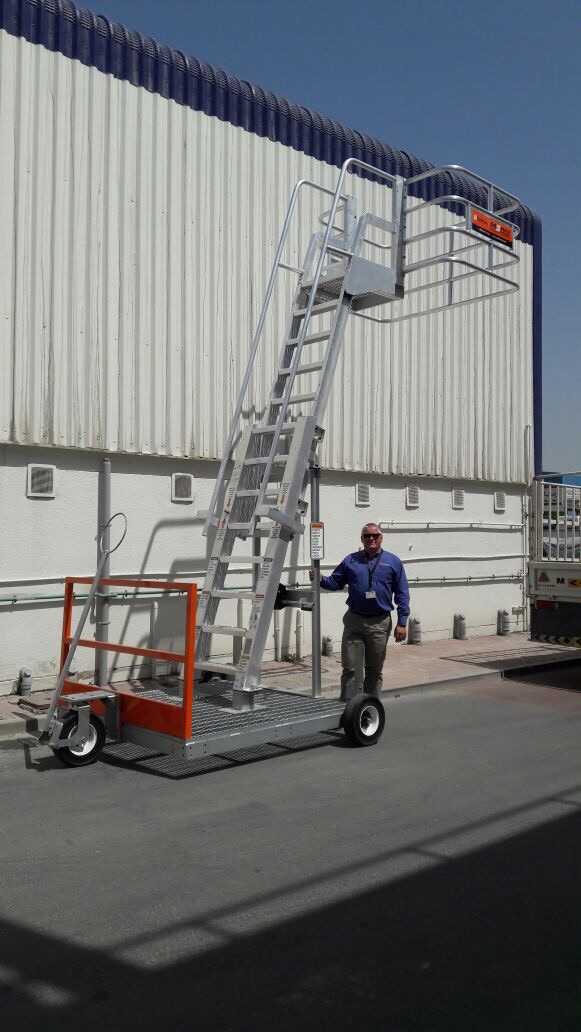
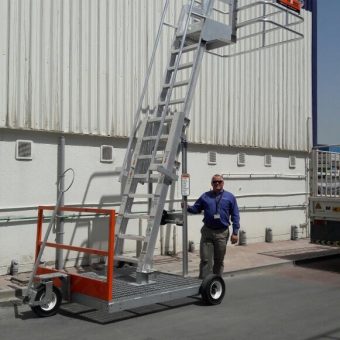
For facilities handling elevated vehicles and equipment, purpose-designed access solutions can help address these risks. The SafeRack MAUI 10/14 Mobile Loading Platform, available through Spacepac, provides mobile access for suitable elevated work applications.
This article explores common access hazards, practical Industrial Fall Protection measures and how the MAUI 10/14 can support safer access planning. Effective Industrial Fall Protection also involves selecting appropriate equipment and following safe work procedures to manage fall risks. By prioritising Industrial Fall Protection, businesses can make informed decisions about their elevated access requirements.
Why Industrial Fall Protection Matters
Falls from height can cause serious injuries and disrupt industrial operations. Common risk areas include loading, unloading, inspections, cleaning and maintenance tasks involving elevated work areas.
Accessing tanker trucks, railcars and equipment above ground level can become hazardous when workers use unsuitable ladders, climb on vehicle components or rely on makeshift platforms.
According to Safe Work Australia’s working at heights guidance, businesses must manage height-related risks and provide safe access to work areas.
Effective Industrial Fall Protection starts with identifying hazards and selecting suitable controls. Where reasonably practicable, businesses should eliminate the need to work at height or introduce purpose-designed access equipment to reduce exposure to falls.
A proactive Industrial Fall Protection strategy considers the task, access requirements and workplace conditions. By prioritising Industrial Fall Protection, businesses can improve access planning and support safer work practices. Appropriate equipment and procedures are essential to effective Industrial Fall Protection.
Common Industrial Access Hazards and How to Address Them
1. Using Unsuitable Ladders to Access Elevated Vehicles
Portable ladders can present fall hazards when accessing tanker trucks, railcars and other elevated surfaces. Ladders that are too short, poorly positioned or unsuitable for the task can increase the risk of slipping or losing balance. Carrying tools and performing two-handed tasks can create additional challenges.
How to address the hazard
Effective Industrial Fall Protection starts with assessing whether a purpose-designed work platform is more suitable than a ladder. Businesses should consider vehicle height, working position and task requirements when selecting access equipment.
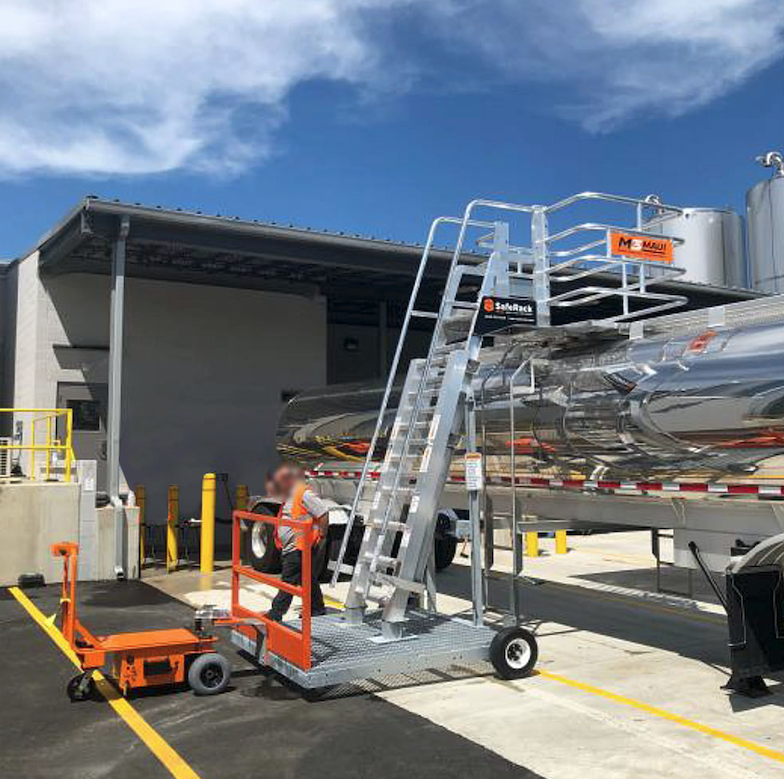
The SafeRack MAUI 10/14 Mobile Loading Platform provides adjustable-height access for suitable elevated work applications. Its mobile design can support changing access requirements across different vehicles.
Choosing appropriate equipment is an important part of Industrial Fall Protection. Regular inspections, safe setup procedures and suitable worker training further support Industrial Fall Protection by helping reduce avoidable access hazards.
2. Unstable or Poorly Positioned Access Equipment
Access equipment must be suitable for its operating environment. Uneven ground, sloping surfaces, obstructions and unsuitable positioning can affect the stability and safe use of a ladder or mobile platform.
A platform that does not align correctly with the work area may also force workers to stretch, lean or reach beyond a comfortable working position. These movements can affect balance and increase the possibility of a fall.
In busy loading areas, equipment may also need to be moved between vehicles or workstations. Without clear procedures, workers may position equipment incorrectly or use it before confirming that it is ready for operation.
How to address the hazard
Before work begins, assess the ground conditions, access route, working height and clearance around the equipment. The access system must be suitable for the surface on which it will be used and the load it is expected to support.
Mobile equipment should be positioned and secured according to the manufacturer’s instructions before workers climb onto it. Operators should understand the equipment’s setup requirements, movement controls and limitations.
The MAUI 10/14 is designed as a self-supporting mobile access system, with a stated support capacity of 227 kg without resting on a vehicle. It can also be reconfigured for parallel or perpendicular positioning relative to a vehicle.
These features may help accommodate changing loading arrangements, provided the platform is configured and used in accordance with the manufacturer’s instructions.
3. Gaps Between Access Platforms and Vehicles
Accessing a vehicle from an elevated platform can introduce additional hazards if the transition between the two surfaces is not adequately controlled.
A gap, height difference or unsuitable access arrangement may create a risk of slipping, tripping or losing balance. Workers may also be tempted to step across an excessive gap or reach over an unprotected edge to complete a task.
These risks are particularly relevant where different vehicle types or loading configurations are handled at the same facility.
How to address the hazard
The access arrangement should be assessed for each intended application. Businesses should consider the distance between the platform and vehicle, the relative heights, the movement of the vehicle and the protection required at exposed edges.
Suitable access equipment and any required edge protection should be selected based on the risk assessment and the manufacturer’s specifications. Vehicle movement must be controlled during the task, and workers should follow established procedures for positioning and using the access system.
The MAUI 10/14 is designed to provide access to elevated vehicles and can be configured for different vehicle orientations. Its suitability for a particular loading arrangement should be confirmed before use.
A purpose-designed platform does not remove every risk associated with vehicle access. The entire transition between the ground, platform and vehicle must be considered as part of the Industrial Fall Protection strategy.
4. Inadequate Fall Protection at Elevated Work Areas
An elevated work area can present a significant risk when workers are exposed to unprotected edges or openings.
This can occur during inspections, maintenance or loading tasks that require employees to work near the edge of a platform or access structure. The risk may increase when workers need to handle tools, inspect equipment or perform tasks that require both hands.
A safe access system should account for both reaching the work area and carrying out the task once the worker arrives.
How to address the hazard
Where reasonably practicable, businesses should prioritise fall prevention measures such as suitable platforms, guardrails and other physical barriers. The specific arrangement should be based on the work activity, equipment design and applicable workplace requirements.
Safe Work Australia explains that fall prevention devices should be considered before relying on work positioning or fall arrest systems where those higher-order controls are reasonably practicable.
The MAUI 10/14 offers a choice of safety cages for applications involving trucks, portable buildings, isotainers and railcars. An optional ladder cage designed for Australian standards is also listed on Spacepac’s product page.
The required cage configuration and compatibility should be confirmed for the intended application. Businesses should not assume that every configuration provides the same level of protection or is suitable for every vehicle.
Selecting the appropriate access equipment and associated protective features can help address exposure to falls while supporting a more controlled working environment.
5. Poor Access Planning During Maintenance
Industrial fall hazards are not limited to loading and unloading. Maintenance teams may need to inspect valves, replace lighting, examine equipment or reach components positioned above ground level.
When suitable equipment is not available, workers may improvise by climbing on machinery, standing on unsuitable objects or using ladders for tasks that require extended reaching.
These arrangements can introduce additional risks, particularly when work is performed frequently or when access requirements change between tasks.
How to address the hazard
Businesses should identify recurring maintenance activities and determine whether a dedicated access solution is appropriate. Planning should consider the required working height, duration of the task, tools involved, frequency of access and available space.
The MAUI 10/14 may be useful for certain maintenance applications because it can be moved between suitable work areas and adjusted for different heights within its specified range.
Spacepac lists a working range of approximately 3,038 mm to 4,267 mm for the MAUI 10/14, with an optional adapter configuration extending the range to approximately 3,658 mm to 4,877 mm.
These specifications can help businesses assess whether the platform is appropriate for their maintenance requirements. The final selection should also consider the required working position, access geometry, ground conditions and any additional protective measures.
Planning access equipment around recurring tasks can reduce dependence on improvised arrangements and help workers follow more consistent procedures.
6. Moving Equipment Without Adequate Procedures
Mobile access platforms offer flexibility, but safe movement and positioning are essential for effective Industrial Fall Protection. Congested work areas, uneven surfaces and incorrect positioning can create additional hazards, particularly where forklifts and vehicles operate nearby.
How to address the hazard
Establish clear procedures for moving, positioning and preparing mobile access equipment. Check ground conditions, access routes and surrounding clearance before moving the platform. Follow the manufacturer’s instructions and complete pre-use checks before allowing access.
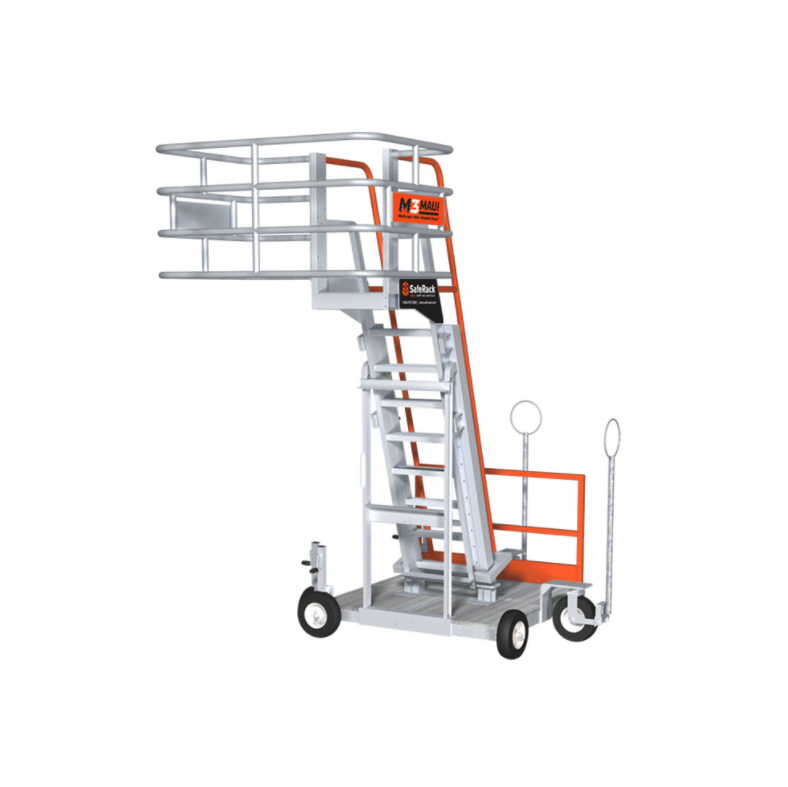
The SafeRack MAUI 10/14 Mobile Loading Platform features forklift tubes for transport, a winch system for raising and lowering the ladder and cage assembly, and puncture-proof tyres.
These features support equipment handling, but safe operating procedures and worker training remain essential. Effective Industrial Fall Protection requires correct equipment setup, while regular inspections help maintain Industrial Fall Protection standards. Integrating these measures into daily operations strengthens Industrial Fall Protection practices.
How the SafeRack MAUI 10/14 Supports Industrial Fall Protection
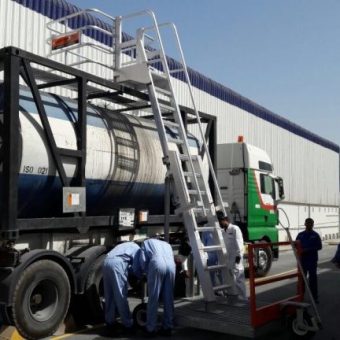
For businesses that regularly need access to tanker trucks, railcars or other elevated work areas, the SafeRack MAUI 10/14 Mobile Loading Platform provides a purpose-designed alternative to relying on temporary ladders.
Its main features include:
- Adjustable working height: The listed working range is approximately 3,038 mm to 4,267 mm, allowing the platform to accommodate a variety of elevated access requirements.
- Self-supporting design: The platform is specified to support 227 kg without resting on a vehicle, an important consideration when assessing applications beyond vehicle access.
- Reconfigurable positioning: The unit can be configured to roll parallel or perpendicular to a vehicle, subject to the manufacturer’s instructions.
- Optional safety cages: Different cage configurations are available for specified applications, including access to trucks and railcars.
- Winch adjustment system: A covered winch is used to raise and lower the ladder and cage assembly.
- Durable construction: The product features aluminium construction with a galvanised base.
- Transport provisions: Standard forklift tubes support transport when the platform is not in use.
- Puncture-proof tyres: The specified 406 mm tyres are designed to avoid flat tyres and flat spots.
Together, these features make the MAUI 10/14 worth considering for operations that need a mobile access solution across different elevated work areas.
However, equipment selection should never be based on specifications alone. Businesses must confirm that the platform is suitable for the intended task, vehicle configuration, operating environment and required level of fall protection.
To review the product details, visit the SafeRack MAUI 10/14 Mobile Loading Platform page on Spacepac’s website.
What Should Businesses Consider When Selecting an Industrial Access Platform?
Choosing suitable access equipment requires more than matching a platform to a particular height. Businesses should assess how workers will use the equipment and what hazards exist throughout the task.
The following considerations can help guide the selection process.
1. Required working height
Determine the height workers need to reach and confirm that the platform’s working range suits the application. Allow for variations in vehicle or equipment dimensions.
2. Nature of the task
Consider whether workers will perform inspections, maintenance, loading activities or other tasks requiring different positions, tools or levels of movement.
3. Ground conditions
Assess whether the platform can be moved and positioned safely on the available surface. Uneven, sloping, slippery or obstructed areas may require additional controls or a different access arrangement.
4. Fall protection requirements
Determine whether guardrails, safety cages, barriers or other protective measures are required. Confirm that the selected configuration is appropriate for the specific application.
5. Equipment capacity and compatibility
Check the manufacturer’s load rating, operating instructions and configuration requirements. Confirm that the equipment is compatible with the intended vehicle or work area.
6. Worker training and inspection
Ensure that workers understand how to use the equipment safely. Establish procedures for pre-use inspections, maintenance, defect reporting and removing damaged equipment from service.
7. Workplace traffic and movement
Consider nearby forklifts, trucks, pedestrian routes and other activities. The access system should fit the wider work area without creating additional hazards.
A structured assessment helps businesses select equipment that supports their operational needs while addressing the actual risks present at the worksite.
Building a More Effective Fall Prevention Strategy
Industrial Fall Protection should form part of a broader workplace risk management process rather than being treated as a single equipment purchase.
The Safe Work Australia risk management guidance outlines the hierarchy of control measures. Businesses should first consider eliminating the hazard, followed by other controls that minimise the risk as far as reasonably practicable.
For elevated industrial tasks, this means considering whether work can be completed at ground level before selecting suitable platforms or other access systems. Where work at height cannot reasonably be avoided, appropriate fall prevention measures should be implemented before relying on less effective controls alone.
A practical approach includes:
- Identifying tasks and locations where falls could occur.
- Reviewing current ladders, platforms and access arrangements.
- Selecting suitable equipment based on the task and risk assessment.
- Providing safe access and exit routes.
- Establishing procedures for equipment setup, use and movement.
- Training workers and supervising safe work practices.
- Inspecting and maintaining equipment according to the manufacturer’s requirements.
- Reviewing controls whenever tasks, equipment or workplace conditions change.
Consultation with workers is also important because employees who regularly perform elevated tasks may identify hazards that are not immediately apparent during a general site inspection.
For Australian workplaces, businesses should refer to the applicable state or territory WHS requirements and relevant codes of practice when developing their procedures. Equipment alone cannot guarantee safety; its effectiveness depends on suitable selection, correct use and the wider control measures in place.
Improve Elevated Access with Spacepac
Effective Industrial Fall Protection starts with identifying access hazards and selecting suitable equipment. For businesses accessing tanker trucks, railcars and elevated work areas, mobile platforms can provide a safer alternative to unsuitable temporary ladders.
The SafeRack MAUI 10/14 Mobile Loading Platform features adjustable working heights, flexible positioning and optional safety cage configurations to support Industrial Fall Protection in suitable applications.
Choosing the right equipment is essential for effective Industrial Fall Protection. Consider working height, vehicle type, site conditions and applicable safety requirements.
Contact Spacepac to explore Industrial Fall Protection solutions for your workplace.