


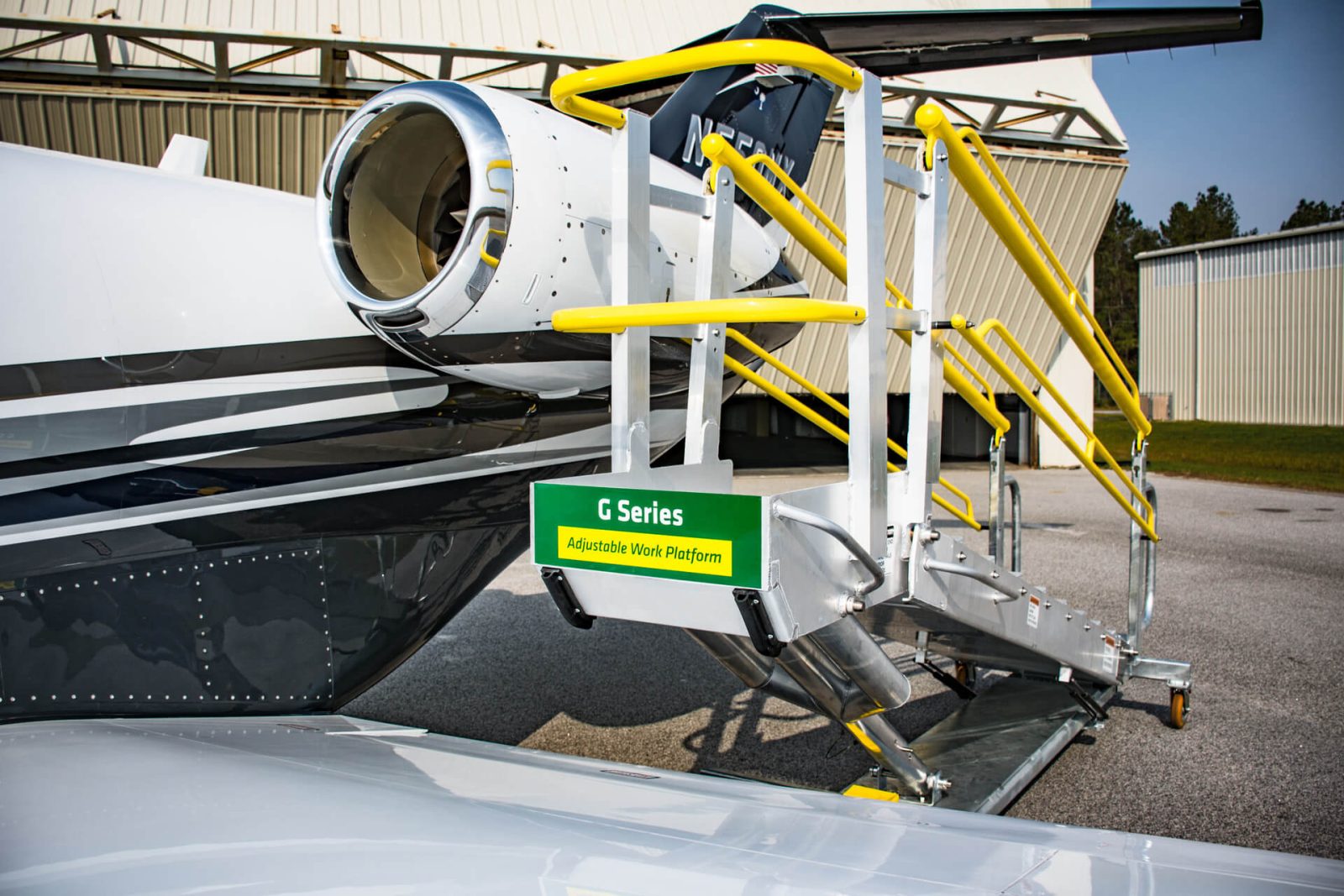
Mobile Access Platforms for Warehouses, Manufacturing & Maintenance Facilities
Mobile Access Platforms provide workplaces with a practical way to reach elevated areas for inspection, equipment servicing and routine maintenance. In warehouses, manufacturing plants and industrial facilities, workers regularly need to access machinery, conveyors, storage infrastructure and other components positioned above ground level. Selecting suitable access equipment can help businesses establish safer working conditions while supporting efficient maintenance operations.
Traditional ladders may be suitable for certain short-duration tasks, but they do not always provide the working space, stability or positioning required for more complex activities. Mobile Access Platforms offer an alternative by combining steps, a raised working surface and protective features in equipment designed for specific access requirements.
For facilities that perform maintenance across multiple work areas, mobility can also be an important consideration. Rather than installing permanent access structures at every location, businesses may be able to use suitable mobile equipment that can be repositioned when required.
SafeRack, available through Spacepac, offers several access solutions designed for industrial environments. The G-Series Adjustable Height Ground Support Mobile Platform, MP Series Mobile Modular Work Platform and C-Series Mobile Work Platform Ladder provide different approaches to elevated access. The MAUI 10/14 Mobile Loading Platform is another option for specialised high-level applications.
Understanding how these Mobile Access Platforms differ can help businesses identify equipment that better suits their working heights, available space and maintenance requirements. Choosing the right Mobile Access Platforms also helps businesses match equipment capabilities to the demands of each task.
Why Mobile Access Platforms Matter in Industrial Workplaces
Working at height can introduce hazards that require careful planning and appropriate controls. Workers may need to reach elevated equipment while carrying tools, inspecting components or completing maintenance procedures. The access method must therefore support the task without creating unnecessary risks.
Mobile Access Platforms provide a defined route to an elevated working surface. Depending on the model, they may include wide steps, handrails, a guarded platform and features that assist with positioning.
These characteristics can be particularly useful when workers need more than a brief reach above ground level. A suitable platform can provide space to stand and organise tools while allowing access to the required work area.
However, not every platform is appropriate for every environment. Working height, platform dimensions, floor conditions, access geometry and load capacity must all be considered before equipment is selected.
Mobile Access Platforms should form part of a broader workplace risk-management process rather than being treated as a standalone safety measure. Businesses should assess the task, identify foreseeable hazards and determine which access method provides the most appropriate controls for their Mobile Access Platforms requirements.
Common Access Challenges in Warehouses
Warehouses contain several areas that may require elevated access during routine operations. These can include storage infrastructure, conveyor systems, lighting, building services and other fixed installations.
Accessing Warehouse Infrastructure
Maintenance teams may need to inspect elevated conveyor components, check building fixtures or complete repairs around warehouse infrastructure. The required working height can vary considerably between tasks.
Mobile Access Platforms with an appropriate platform height can provide access without requiring workers to improvise an elevated standing position. A platform with sufficient working space may also help accommodate tools and small parts needed for the job.
The G-Series is worth considering when the same facility performs tasks at different heights. Its adjustable-height design allows the platform to be set to a suitable level within its specified operating range.
Maintaining Access in Busy Work Areas
Warehouse layouts can change as stock, equipment and workstations are repositioned. Access equipment must fit the available space and allow workers to reach the required location without obstructing normal operations.
Before introducing Mobile Access Platforms into a warehouse, businesses should assess aisle widths, turning space, floor surfaces and nearby vehicle movements.
Equipment should be moved only in accordance with the manufacturer’s instructions. Workers should not climb onto a platform while it is being repositioned unless the manufacturer specifically permits that operation.
Supporting Planned Maintenance
Planned maintenance often involves repeated access to the same equipment. Selecting suitable Mobile Access Platforms for these recurring tasks can help standardise access arrangements.
For example, a maintenance team may use a designated platform for inspections at a particular working height. Establishing consistent procedures for positioning, checking and using the equipment can support a more controlled maintenance process.
The appropriate solution depends on the actual task. Warehouse picking, high-level building maintenance and servicing industrial machinery may require different access equipment.
Mobile Access Platforms for Manufacturing Facilities
Manufacturing environments often contain production lines, conveyors, processing equipment and machinery with components positioned above floor level. Maintenance workers may need to inspect, adjust or service these components without disrupting surrounding operations unnecessarily.
Mobile Access Platforms can help address some of these access requirements when the selected equipment is suitable for the work.
Accessing Production Equipment
Manufacturing maintenance may involve checking guards, inspecting mechanical components or reaching service points around production equipment.
A platform with sufficient working space can provide a more suitable work area than a ladder for certain tasks. Handrails, appropriate steps and a defined standing surface can also support a more controlled approach to elevated work.
The MP Series is particularly relevant when a task requires a larger working platform. Its published design features a 9 ft × 3 ft working surface, powder-coated handrails and a 45-degree stair configuration.
This larger surface can be useful when the work requires space for tools, parts and equipment. Nevertheless, the load rating and intended occupancy must be confirmed for the specific model before use.
Supporting Equipment Inspections
Regular inspections help maintenance teams identify wear, damage or developing equipment issues. Some inspection points may be difficult to reach from ground level.
Mobile Access Platforms can provide access to selected elevated inspection points, provided the platform is appropriate for the required height and position.
When evaluating a platform for manufacturing use, consider the location of the equipment, surrounding obstructions and the amount of space needed to perform the inspection.
A cantilever platform may be useful in applications where the worker needs to reach over or beyond the platform’s base. However, the geometry of the equipment and the manufacturer’s permitted operating conditions must be assessed carefully.
Reducing Unnecessary Equipment Repositioning
Manufacturing facilities may have multiple maintenance points across a production area. Selecting equipment that can be positioned efficiently can help reduce unnecessary handling and improve task planning.
The G-Series offers adjustable height and swivel castors, while the C-Series is designed for mobile access to tall industrial machinery and other elevated work areas.
The choice between these Mobile Access Platforms should depend on the required height, reach, available clearance and movement requirements. A platform that works well beside one machine may not be suitable for a different installation.
SafeRack Mobile Access Platforms Available Through Spacepac
SafeRack offers several platform configurations designed for different elevated-access requirements. The following products are worth considering when assessing solutions for warehouses, manufacturing facilities and industrial maintenance teams.
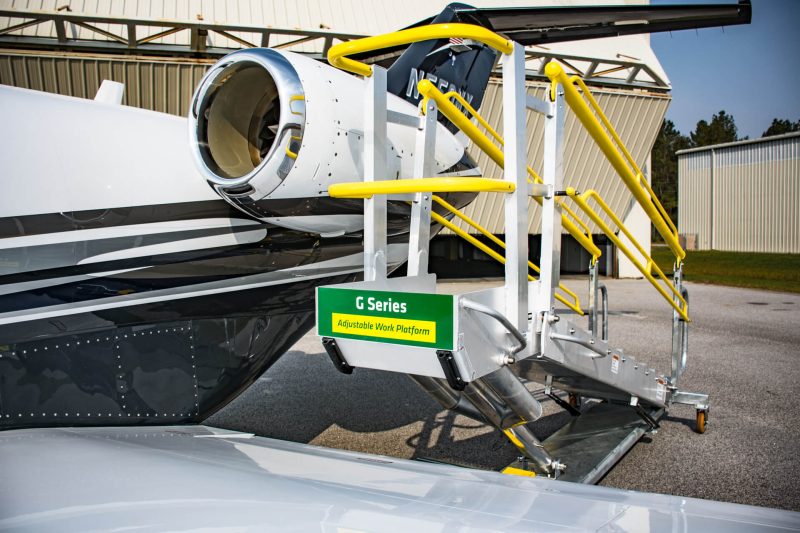
1. G-Series Adjustable Height Ground Support Mobile Platform
The G-Series is a strong option for facilities that need adjustable-height access across multiple work areas.
Its height can be adjusted by removing a locking pin and securing it again at the selected setting. Gas springs assist with raising the platform, while downward pressure lowers it. The design does not rely on hydraulic systems for height adjustment.
The platform and steps are designed to self-level as the height changes. The product information also specifies steps approximately 610 mm wide and a working area of six square feet.
Other features include:
- Adjustable working height within the model’s specified range.
- Gas-assisted height adjustment.
- Lightweight aluminium upper structure.
- Steel base designed to provide stability.
- Swivel castors for positioning.
- A platform with a full toeboard.
These features make the G-Series worth evaluating for recurring maintenance tasks where different working heights are required.
Potential applications include accessing elevated building services, inspecting suitable machinery components and performing selected warehouse maintenance activities.
The G-Series should not be assumed to suit every task simply because its height is adjustable. Buyers should confirm the required platform height, load capacity, access conditions and operating limitations before selecting a model.
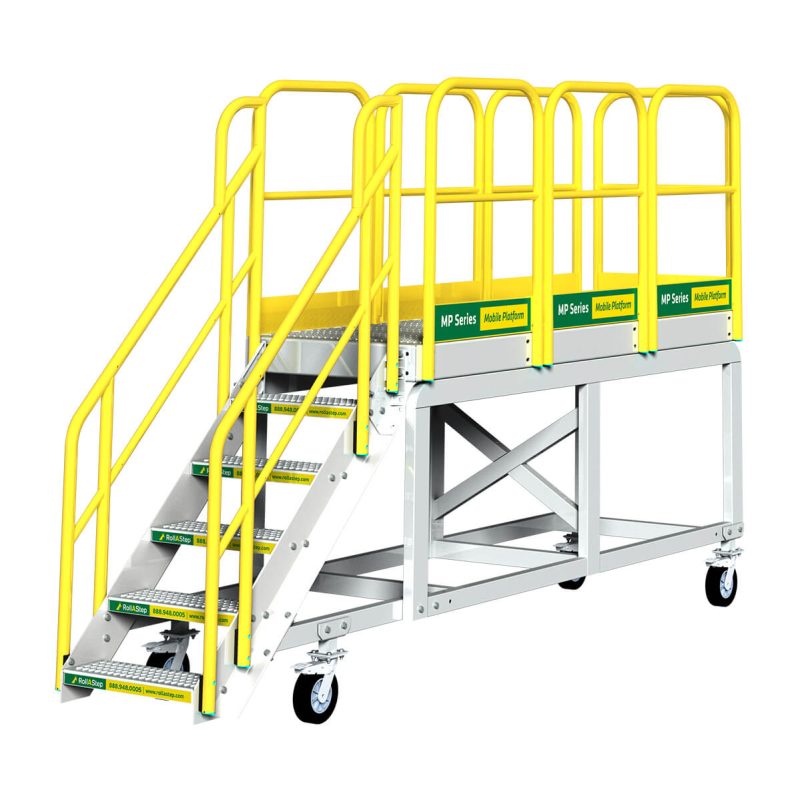
2. MP Series Mobile Modular Work Platform
The MP Series is designed for applications where workers need a larger working surface than a conventional ladder typically provides.
Its 9 ft × 3 ft platform offers room for workers and equipment, subject to the applicable load rating and occupancy requirements. The design includes powder-coated handrails, a 45-degree stair arrangement and lightweight aluminium construction.
The MP Series is available in several configurations with platform heights ranging from approximately 686 mm to 1,829 mm, depending on the selected model.
Key considerations include:
- Platform dimensions and available workspace.
- Required access height.
- Space needed for workers and tools.
- Handrail configuration.
- The manufacturer’s restrictions on occupancy and loading.
- Access to the target work area.
The MP Series may be relevant to manufacturing maintenance, industrial inspections and other tasks that require a more substantial working surface.
Its removable handrail options also allow certain configurations to be adapted to specific access arrangements. Any changes must follow the manufacturer’s instructions and must not compromise required fall protection.
When comparing Mobile Access Platforms, businesses should consider whether the work requires a broad platform for tools and parts or a smaller unit that is easier to position in a restricted area.
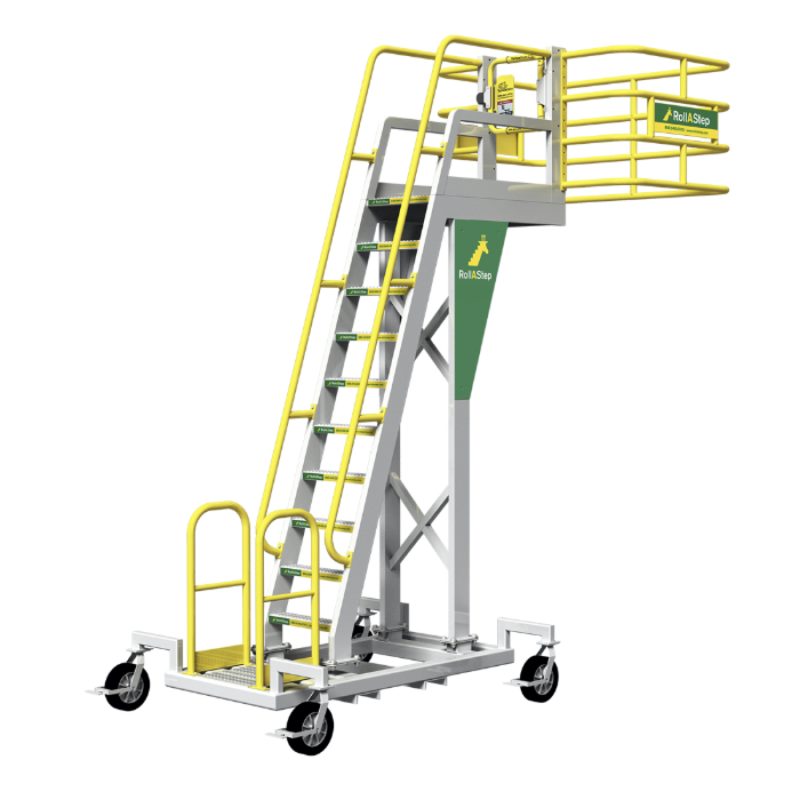
3. C-Series Mobile Work Platform Ladder
The C-Series is designed to provide access to railcars, tank trucks and other tall industrial machinery. Its cantilever configuration can extend the working platform beyond the base of the chassis.
The published product information specifies a platform extension of approximately 736.6 mm beyond the base. The platform provides six square feet of working space.
Other features include:
- A steel base designed to provide counterbalance.
- A lightweight aluminium upper structure.
- Large, puncture-resistant tyres.
- Swivel wheels for positioning.
- Locking wheels for stability.
- Forklift pockets to assist with longer-distance relocation.
- Handrails around the working platform.
These characteristics make the C-Series relevant when equipment geometry makes direct access difficult.
In suitable applications, the cantilever arrangement can help workers reach components positioned beyond the chassis without relying on the equipment being serviced for support.
Potential applications include selected machinery inspections, elevated industrial maintenance and access to suitable vehicle-mounted or rail-related equipment.
The C-Series should be evaluated against the actual position of the work area. Buyers need to confirm the required height, reach, ground conditions and permitted operating configuration.
Of the Mobile Access Platforms discussed here, the C-Series is the most specialised choice for applications where extended reach is an important consideration.
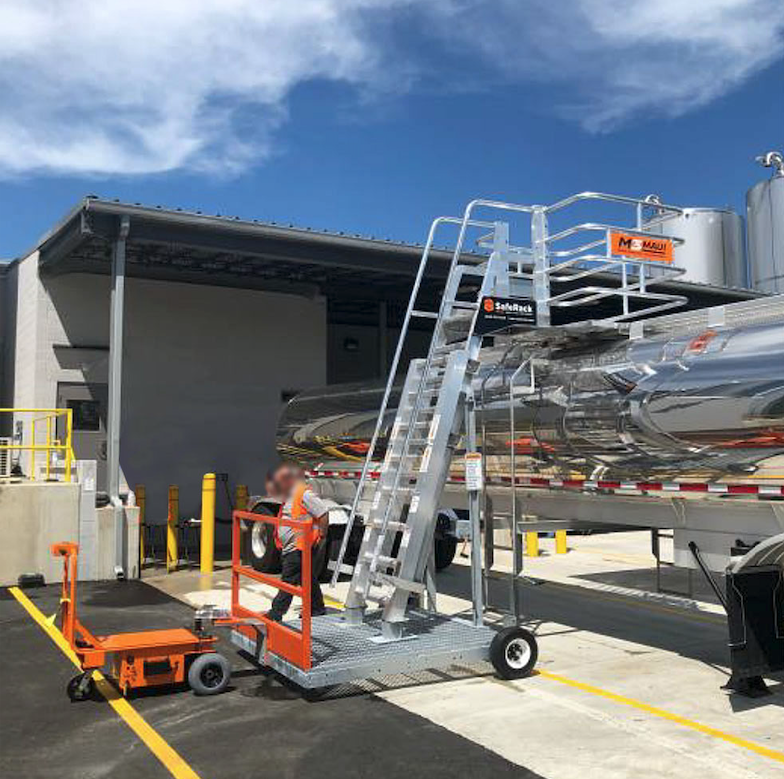
4. MAUI 10/14 Mobile Loading Platform
The MAUI 10/14 is designed primarily for elevated access around tanker trucks, railcars and other suitable work areas. It can also be considered for selected industrial inspection and maintenance applications where its configuration is appropriate.
The published working-height range is approximately 3,048 mm to 4,267 mm. The platform is specified to support 227 kg without resting on a vehicle.
Its features include:
- A winch system for raising and lowering the ladder and cage assembly.
- Puncture-proof tyres.
- Forklift tubes for transport.
- Reconfigurable positioning relative to a vehicle.
- Optional cage configurations for specified applications.
- An aluminium structure with a galvanised base.
The MAUI 10/14 is best treated as a specialised high-level access option rather than a general-purpose platform for every warehouse task.
Businesses considering this unit should verify the required working height, cage configuration, access position and compatibility with the intended application.
The published support capacity must also be interpreted according to the manufacturer’s conditions and instructions. It should not be confused with a universal working-load rating for every configuration.
For facilities that regularly service elevated vehicle or equipment surfaces, the MAUI may be worth assessing alongside other Mobile Access Platforms.
How to Choose the Right Mobile Access Platforms
Product selection should begin with the task rather than the equipment catalogue. A platform that suits a manufacturing maintenance bay may be unsuitable for a narrow warehouse aisle or a high-level vehicle inspection.
1. Confirm the Required Working Height
Measure the height of the actual work area and determine the required standing position. Do not select equipment based solely on the maximum height stated in its name.
Check the manufacturer’s specifications for platform height and any applicable working-height guidance. Confirm that the chosen configuration allows workers to reach the task without excessive stretching or leaning.
2. Assess Platform Size and Reach
Consider how much room the worker needs to stand, move and organise tools.
A larger platform may be useful for tasks involving multiple tools or replacement parts. A cantilever design may help with specific access geometries, while a compact platform may be easier to position in restricted spaces.
The platform must still be positioned in accordance with its instructions and limitations.
3. Check Load Capacity
Calculate the total load the equipment must support, including workers, tools and materials.
Confirm the applicable capacity for the exact model and configuration. Do not assume that products in the same series share identical ratings.
The platform must never be loaded beyond its specified limits.
4. Consider Mobility and Floor Conditions
Mobile equipment must be suitable for the surfaces and routes where it will be used.
Assess floor levelness, surface condition, available turning space and nearby hazards. Check whether castors or wheels are appropriate for the environment and whether the platform can be positioned securely.
Mobility does not mean that a platform can be moved safely under every condition. Follow the manufacturer’s instructions for movement, setup and use.
5. Review Fall-Protection Features
Assess the need for handrails, guardrails, toeboards and other protective features.
The required safeguards depend on the equipment design, task and applicable workplace requirements. Optional components must be selected and installed according to the manufacturer’s instructions.
6. Evaluate Frequency of Use
A platform used daily for recurring maintenance may have different requirements from one used occasionally for inspections.
Consider storage, movement, inspection procedures and the availability of trained personnel. These practical factors can influence whether an adjustable-height, large-surface or specialised high-level model is appropriate.
Safe Work Practices When Using Mobile Access Platforms
Selecting suitable equipment is only one part of controlling risks associated with working at height. Mobile Access Platforms must be inspected, positioned and used in accordance with the manufacturer’s instructions and the workplace’s risk-management procedures.
Before use, workers should check the equipment for visible damage, missing components, defective wheels, damaged steps and other issues that could affect safe operation.
The work area should be assessed for uneven surfaces, obstructions, overhead hazards and nearby vehicle movements. The platform must be positioned and secured as instructed before a worker climbs onto it.
Workers should use the designated access route and maintain safe footing. Tools and materials must be managed so that they do not obstruct movement or create falling-object hazards.
Do not move a platform while it is occupied unless the manufacturer explicitly permits that operation and all specified conditions are met. Never bypass safety features or modify the equipment without authorisation.
Training and supervision should reflect the equipment being used and the hazards associated with the task. Inspections and maintenance should follow the manufacturer’s requirements, with damaged equipment removed from service until appropriately assessed and repaired.
For Australian workplaces, Safe Work Australia’s guidance on managing the risks of falls at workplaces provides a useful reference for planning work at height. Businesses should also check the WHS requirements and approved codes of practice applicable in their state or territory.
Mobile Access Platforms can contribute to safer access arrangements, but they do not eliminate every hazard. Effective risk control requires suitable equipment, safe work procedures and ongoing review of Mobile Access Platforms in the workplace.
Improve Elevated Access Planning with Spacepac
Warehouses, manufacturing plants and maintenance facilities have different access requirements. The right equipment depends on the working height, available space, reach, load and nature of the task.
SafeRack Mobile Access Platforms offer several configurations for businesses assessing elevated access solutions.
The G-Series is worth considering for adjustable-height applications. The MP Series provides a larger working surface for suitable maintenance tasks. The C-Series addresses specialised access requirements around tall industrial machinery, while the MAUI 10/14 provides a high-level option for appropriate vehicle and equipment applications.
Comparing these Mobile Access Platforms against actual workplace conditions can help businesses identify a more suitable solution for their operations.
Spacepac can assist businesses in assessing available access equipment against their requirements and selecting suitable Mobile Access Platforms.
Contact Spacepac on 1300 763 444 or email sales@spacepac.com.au to discuss Mobile Access Platforms for your warehouse, manufacturing facility or maintenance operation.