


From Vehicle to Worksite: Improving Equipment Transport for Field Service Teams
Field service teams regularly transport heavy, bulky and specialised equipment between vehicles, customer premises, workshops and job sites. Whether delivering commercial coffee machines, installing photocopiers, servicing office equipment or moving industrial components, transporting equipment safely and efficiently is an important part of daily operations.
However, one of the most challenging stages of a service job is often moving equipment from the delivery vehicle to its final working location. Equipment may need to be unloaded from a van or truck, transferred across parking areas, manoeuvred through doorways and positioned inside offices, retail stores or commercial facilities. Without suitable material handling equipment, these tasks can involve unnecessary lifting, awkward movements and repeated manual handling.
For businesses that depend on field service personnel, improving Equipment Transport is about more than simply moving items from one location to another. It involves selecting practical handling solutions that reduce physical strain, improve workplace safety and allow employees to complete deliveries and service installations more efficiently.
A suitable equipment transport trolley can help simplify these processes by providing a stable platform for moving heavy and awkward loads. One solution designed specifically for these applications is the Demtruk Folding Cart DELUX 2.0, a folding manual handling cart with a maximum load capacity of 220 kg.
Featuring an adjustable working height, wider platform options, removable extensions, adjustable load straps and improved braking, the Demtruk DELUX 2.0 provides a practical solution for moving equipment between vehicles and customer workspaces.
This article explores the common challenges associated with field service equipment handling and how businesses can improve their transport processes using suitable material handling equipment.
1. Understanding the Challenges of Equipment Transport for Field Service Teams
Field service operations involve a variety of equipment types, each presenting different handling requirements. Some products are heavy but compact, while others are relatively lightweight but difficult to grip, position or manoeuvre.
Commercial coffee machines, photocopiers, printers and specialised service equipment are examples of loads that can be particularly difficult to handle manually.
Unlike standard cartons or palletised goods, these items may have irregular dimensions, delicate components and limited lifting points. Their shape can make it difficult for employees to maintain a comfortable lifting position.
Several challenges commonly affect Equipment Transport operations.
Moving Heavy and Awkward Equipment
Heavy equipment can place considerable physical demands on employees, particularly when lifting from vehicle floors or transferring loads onto work surfaces.
Large photocopiers and commercial coffee machines often require careful handling because of their weight, dimensions and internal components.
Without a suitable trolley or platform, workers may need to lift equipment manually or rely on improvised handling methods.
A purpose-designed equipment transport cart provides a supporting surface that allows loads to be transferred and moved without requiring employees to carry the entire weight throughout the journey. This can help make Equipment Transport more manageable while reducing unnecessary manual handling.
Choosing the right handling equipment also helps improve Equipment Transport procedures, providing better support when moving bulky items between vehicles and customer locations. For field service teams, efficient Equipment Transport can make daily handling tasks more practical and manageable.
Transferring Equipment Between Vehicles and Buildings
Moving equipment from a delivery vehicle to a customer location often involves several stages.
Employees may need to:
- Unload equipment from a van or truck.
- Position the equipment onto a suitable transport platform.
- Move the load across parking areas or loading zones.
- Navigate doorways, corridors and restricted spaces.
- Transfer the equipment into an office, workshop or retail environment.
- Position the equipment for installation, servicing or demonstration.
Each stage introduces different handling considerations and can make Equipment Transport more challenging, particularly when dealing with bulky or heavy items.
An adjustable equipment transport trolley can help make these transfers more manageable by providing a consistent platform height and a controlled method of moving the load. This supports more efficient Equipment Transport between vehicles and customer premises.
Limited Space in Customer Premises
Field service personnel frequently work in environments where space is restricted.
Offices, retail stores, commercial kitchens and workshops may have narrow access points, furniture, shelving and other obstacles.
A bulky handling trolley can make it difficult to navigate these areas, making Equipment Transport more challenging.
For this reason, handling solutions should provide a balance between load capacity, platform dimensions and manoeuvrability to support efficient movement through confined spaces.
Repeated Manual Handling
Field service employees may complete multiple service visits throughout a working day.
Repeatedly lifting, carrying and repositioning heavy equipment can increase physical demands, particularly when workers are handling similar loads across several locations.
Improving Equipment Transport procedures can help reduce unnecessary manual handling, minimise physical strain and support more consistent workplace practices.
2. Why Equipment Transport Should Be Part of Your Workplace Safety Strategy
Manual handling is an important consideration for businesses involved in equipment deliveries, installations and maintenance.
According to Safe Work Australia, hazardous manual tasks can contribute to musculoskeletal disorders and workplace injuries associated with Equipment Transport.
These tasks may involve:
- Repetitive or sustained force.
- High or sudden force.
- Repetitive movements.
- Awkward or sustained postures.
- Exposure to vibration.
When employees manually lift or carry heavy equipment, the risk can increase if the load is difficult to grip, unstable or positioned at an unsuitable height.
A properly selected equipment transport trolley can help reduce the need for carrying and repositioning loads manually, supporting safer Equipment Transport practices.
Reducing Physical Strain
Using a handling cart allows equipment to rest on a supporting platform during movement.
Instead of carrying a heavy machine over a distance, employees can manoeuvre it using the cart’s handles and wheels.
This can help reduce the physical demands associated with transporting suitable loads.
Improving Load Stability
Equipment can shift during movement if it is not adequately supported or secured.
A suitable transport platform combined with adjustable load straps helps keep equipment in position while the trolley is being manoeuvred.
The Demtruk DELUX 2.0 includes two adjustable load straps to provide additional load security.
Supporting Safer Working Practices
Equipment transport should form part of a broader workplace risk management process.
Businesses should assess the load, travel path, floor conditions, access restrictions and handling requirements before selecting an appropriate trolley.
A handling cart does not eliminate every manual handling risk. Employees must still follow safe operating procedures, observe the rated capacity and use appropriate techniques when loading, unloading and moving equipment.
3. Choosing the Right Equipment Transport Trolley for Field Service Applications
Not all transport trolleys are designed for the same applications.
A standard platform trolley may be suitable for moving cartons or general warehouse materials, but field service teams often require additional features to handle bulky equipment and transfer loads between vehicles and buildings.
When selecting equipment transport equipment, businesses should consider several important characteristics.
Load Capacity
The trolley must be suitable for the weight of the equipment being transported.
The Demtruk Folding Cart DELUX 2.0 has a maximum load capacity of 220 kg, making it suitable for a range of heavy equipment handling applications within its rated capacity.
Employees should always consider the combined weight of the load and any accessories or attachments when assessing suitability.
Adjustable Platform Height
Different vehicles and equipment configurations can create challenges when transferring loads.
A height-adjustable platform can help position equipment at a more practical working level.
The Demtruk DELUX 2.0 features an adjustable load height from 700 mm to 940 mm in 50 mm increments.
This adjustment allows users to select a platform height appropriate for the handling task.
Platform Dimensions
The size of the platform is another important consideration.
Equipment with larger footprints may require additional support to maintain stability during movement.
The Demtruk DELUX 2.0 offers two platform configurations:
-
Standard platform: 850 mm long x 660 mm wide, with a 150 mm extension.
-
Large platform: 1,200 mm long x 660 mm wide, with a 150 mm extension.
The wider 660 mm platform provides additional support for suitable equipment, while the removable extension offers extra platform length when required.
Manoeuvrability and Braking
Field service teams regularly work in environments where precise positioning is necessary.
Swivel castors help users change direction, while braking systems provide additional control when positioning equipment.
The Demtruk DELUX 2.0 incorporates a 125 mm front swivel braked castor and two rear pneumatic braked wheels measuring 260 x 85 mm.
Its braking configuration is designed to provide improved control during equipment movement and when the cart is used as a workstation or display platform.
Folding Design and Storage
Service vehicles have limited storage capacity.
Handling equipment needs to be practical to transport without occupying unnecessary space.
A folding base makes it easier to store the trolley when it is not being used.
The Demtruk DELUX 2.0 features a foldable base and comes with a dedicated carry bag to help protect the base during transport and storage.
4. Introducing the Demtruk Folding Cart DELUX 2.0
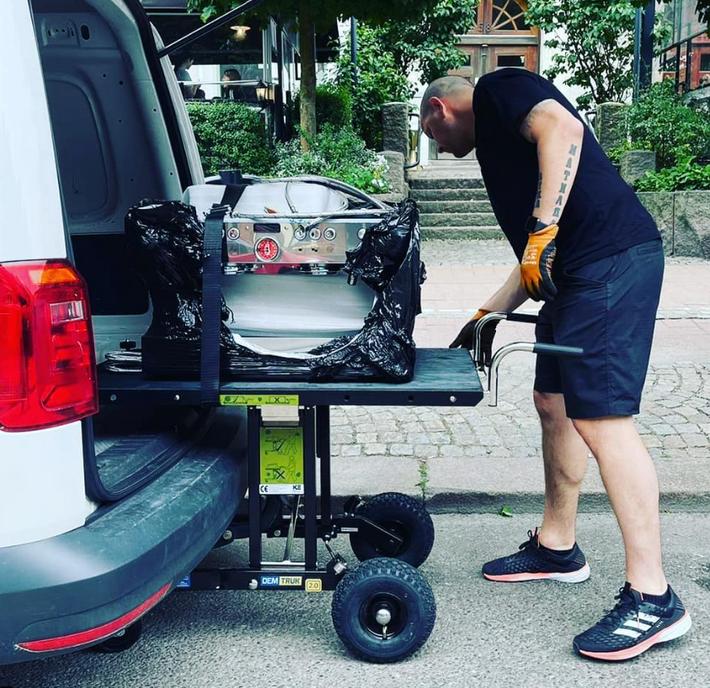
The Demtruk Folding Cart DELUX 2.0 is designed for moving heavy and awkward-to-lift equipment between vehicles and customer premises.
It is particularly suited to applications involving commercial coffee machines, large photocopiers and other equipment that needs to be transported into offices, shops and commercial facilities for servicing, installation or demonstration.
With a maximum load capacity of 220 kg, the Demtruk provides a supporting platform for equipment that would otherwise require considerable manual handling.
Its folding base, adjustable platform height and interchangeable top configurations make it a practical option for businesses looking to improve their equipment transport procedures.
Designed for Single-Person Operation
One of the key advantages of the Demtruk DELUX 2.0 is its suitability for single-person operation when the load, access conditions and risk assessment permit.
For field service businesses, this can help reduce the need to allocate additional personnel solely for equipment movement.
Employees can position the load on the platform, secure it using the supplied straps and manoeuvre the cart using its handles.
The handles are removable at the touch of a button on the sides, allowing the cart to be configured for different handling requirements.
However, single-person operation should only be considered when the load and working conditions have been assessed as suitable.
Improved Platform Width and Support
The DELUX 2.0 platforms have been widened to 660 mm overall.
This provides additional platform width for accommodating suitable equipment and supporting more stable load positioning.
Both platform configurations include a removable 150 mm extension, allowing users to increase the available platform length when necessary.
The two available platform options are:
Standard Top – KE470/00
-
Platform dimensions: 850 mm L x 660 mm W.
-
Additional extension: 150 mm.
-
Platform weight: 15 kg.
Large Top – KE471/00
- Platform dimensions: 1,200 mm L x 660 mm W.
- Additional extension: 150 mm.
- Platform weight: 21 kg.
The choice between the two configurations depends on equipment dimensions, weight distribution and the available working space.
Roll-Off Platform for Easier Loading
The roll-off platform design supports the loading and unloading of equipment.
This is particularly useful when moving machines between a vehicle and the trolley.
Rather than relying entirely on manual lifting, the platform configuration provides a practical surface for transferring suitable equipment.
The objective is to make the loading process more controlled while reducing unnecessary handling.
Adjustable Working Height
The Demtruk DELUX 2.0 features a height-adjustable platform that can be raised or lowered in 50 mm increments.
Its specified adjustment range is 700 mm to 940 mm.
This allows field service personnel to select a suitable working height for different vehicle and equipment configurations.
An adjustable platform can be particularly useful when transferring equipment from vehicle storage areas or positioning machines for servicing and demonstration.
Additional Load Security
The trolley comes with two adjustable load straps.
These straps provide additional security by helping restrain suitable equipment on the platform during movement.
Proper load positioning and securing are essential when transporting heavy or awkwardly shaped items.
Employees should ensure that the equipment is stable and that the straps are appropriately positioned before moving the cart.
5. Key Features That Improve Equipment Transport Efficiency
The Demtruk DELUX 2.0 incorporates several features intended to improve equipment handling across field service, courier and delivery applications.
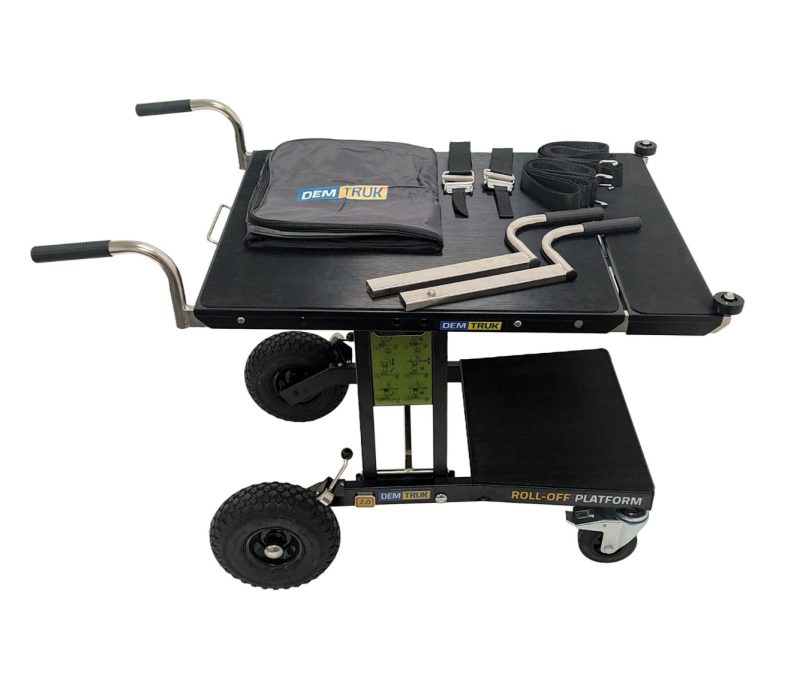
Foldable Base
The folding base makes the trolley easier to store and transport between service locations.
Its compact folded configuration is particularly useful for businesses operating from vans and other service vehicles.
The base has the following specifications:
-
Part number: KE450/00.
-
Unit dimensions: 310 x 988 x 384 mm.
-
Unit weight: 18.3 kg.
-
Packed dimensions: 1,055 x 345 x 408 mm.
-
Packed weight: 26 kg.
-
Maximum load capacity: 220 kg.
Front and Rear Braking
The DELUX 2.0 includes braking features on both the front caster and rear wheels.
The 125 mm front swivel braked castor provides directional flexibility and braking capability.
The rear axle-mounted pneumatic wheels measure 260 x 85 mm and feature brakes.
These features help improve control when manoeuvring and positioning equipment.
The front caster brakes also provide additional stability when the Demtruk is used as a workstation or display table, subject to suitable positioning and operating conditions.
Detachable Lower Shelf
Featuring a quick-release design and matching rubber matting, the lower shelf provides additional storage capacity.
Field service personnel can use this area for suitable tools, accessories and smaller equipment required during a service visit.
Keeping essential items together can help reduce unnecessary trips between the vehicle and work area.
Removable Handles
The Demtruk DELUX 2.0 includes two rear handles and two front stair-climb handles.
The removable handle arrangement allows users to configure the cart according to the handling task.
The additional pair of handles also supports step-carry capability when the equipment needs to be carried by two people.
Four pallet carry handles are included for situations where two-person carrying is required.
This provides additional flexibility when moving the folded or configured unit, subject to safe handling procedures and the weight involved.
Carry Bag
For field service teams, this can help keep the trolley and its accessories organised inside a service vehicle.
It also helps reduce exposure to damage from other equipment stored in the vehicle.
6. Practical Applications: Where Can the Demtruk DELUX 2.0 Be Used?
The Demtruk DELUX 2.0 is suited to businesses that regularly transport heavy or awkward equipment between vehicles and customer premises.
Its platform configuration and load capacity make it relevant to several field service applications.
Commercial Coffee Machine Installations
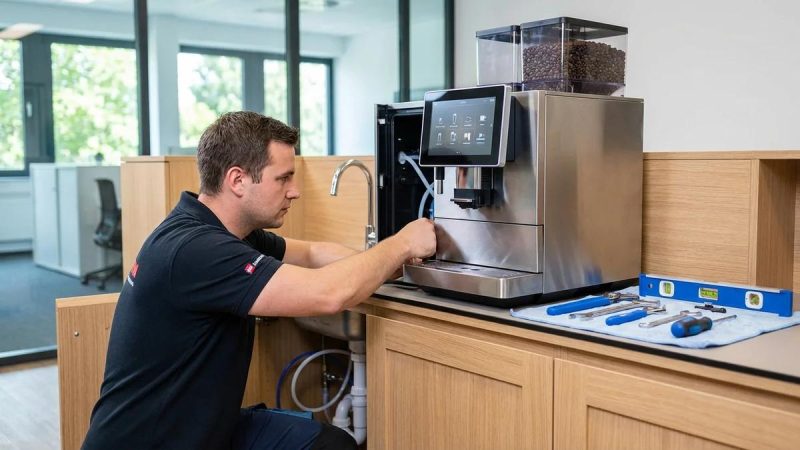
Commercial coffee machines can be difficult to handle because of their weight, dimensions and delicate components.
Installers may need to unload machines from delivery vehicles and move them into cafes, restaurants, hotels and other commercial premises.
A suitable equipment transport cart provides a supporting platform that can help move these machines through the delivery process.
The Demtruk DELUX 2.0 can be considered for coffee machine installations where the machine’s dimensions, weight and access conditions are compatible with the trolley.
Photocopier and Printer Deliveries
Their size and weight can make it difficult for employees to maintain a comfortable grip while navigating corridors, doorways and office spaces.
An equipment transport trolley provides a platform to support the machine during movement.
The adjustable platform height and two available top sizes give businesses flexibility when selecting a configuration for compatible photocopier models.
Office Equipment Servicing
Field technicians often carry tools, replacement parts and equipment when attending service appointments.
The Demtruk’s lower shelf can provide additional storage for suitable accessories and tools.
This helps keep frequently used items organised and accessible during a job.
The cart can also serve as a temporary workstation or display platform when positioned appropriately and with its brakes engaged.
Retail Equipment Installation
Retail environments often require equipment to be delivered and positioned without disrupting normal business operations.
Point-of-sale equipment, commercial appliances and other bulky items may need to be moved through entrances, customer areas and back-of-house spaces.
A manoeuvrable transport trolley can help employees manage these movements more efficiently.
Courier and Delivery Operations
Courier businesses regularly handle a variety of bulky or heavy goods.
Repeated lifting and carrying can increase the physical demands placed on delivery personnel.
Using suitable equipment transport solutions can help simplify the movement of compatible loads between delivery vehicles and customer premises.
The Demtruk DELUX 2.0 is particularly relevant to courier and service businesses handling equipment within its 220 kg rated capacity.
7. How to Improve the Equipment Transport Process from Vehicle to Worksite
Selecting the right trolley is only one part of improving equipment transport.
Businesses should also establish consistent procedures for loading, moving and unloading equipment.
The following practices can help field service teams improve their handling processes.
Step 1: Assess the Equipment Before Loading
Before moving equipment, employees should assess:
-
Total load weight.
-
Equipment dimensions.
-
Centre of gravity and weight distribution.
-
Available lifting and handling points.
-
Whether the equipment requires additional protection.
-
Whether the load is suitable for the selected trolley.
The Demtruk DELUX 2.0 has a maximum load capacity of 220 kg. Equipment exceeding this capacity should not be transported using the cart.
Step 2: Select the Appropriate Platform
Choose the platform configuration according to the dimensions of the equipment.
The 850 mm standard platform may be appropriate for more compact machines, while the 1,200 mm large platform provides additional length for larger equipment.
Both platforms are 660 mm wide and include a removable 150 mm extension.
The load must remain adequately supported and stable throughout the handling process.
Step 3: Adjust the Platform Height
Set the platform to a suitable height before transferring the equipment.
The Demtruk DELUX 2.0 allows adjustment between 700 mm and 940 mm in 50 mm increments.
Selecting an appropriate height can help make the transfer between the vehicle and trolley more manageable.
Step 4: Secure the Equipment
Position the equipment correctly and use the two supplied adjustable load straps where appropriate.
Check that the equipment is stable before moving the trolley.
The straps should be suitable for the load and positioned so they do not damage sensitive components.
Step 5: Check the Travel Path
Before moving equipment, inspect the route between the vehicle and the final destination.
Consider:
-
Floor condition.
-
Ramps and changes in floor level.
-
Doorway and corridor widths.
-
Pedestrian traffic.
-
Obstacles and restricted access areas.
-
Available turning space.
This is particularly important in customer premises where access conditions may vary between locations.
Step 6: Manoeuvre and Position the Load
Use the trolley handles to guide the equipment along the planned route.
Avoid sudden movements and maintain control of the load.
When the destination is reached, engage the brakes before positioning or transferring the equipment.
Step 7: Unload and Prepare for the Next Job
Once the equipment has been transferred safely, remove the straps and unload the platform using an appropriate handling method.
The trolley can then be folded and stored in its carry bag when required.
Establishing a consistent process helps field service teams manage equipment transport more efficiently across different customer locations.
8. How the Demtruk DELUX 2.0 Can Support Field Service Productivity
Improving equipment transport can contribute to better operational efficiency across field service businesses.
Although the exact benefits depend on the equipment, work environment and operating procedures, several advantages are worth considering.
Reduced Dependence on Manual Carrying
A suitable transport trolley allows employees to move equipment on a supporting platform rather than carrying the full load over a distance.
This can help reduce unnecessary physical exertion during deliveries and installations.
More Flexible Staffing
The Demtruk DELUX 2.0 is designed for single-person operation when the load and working conditions permit.
This may reduce the need to allocate a second employee solely to move compatible equipment.
However, larger, heavier or difficult-to-access loads may still require two-person handling or additional equipment.
Better Organisation
The lower shelf and supplied accessories provide additional functionality for field service teams.
Employees can keep suitable tools and accessories together, helping streamline the equipment handling process.
Flexible Equipment Configuration
The availability of standard and large platform tops gives businesses the option to configure the cart according to different equipment dimensions.
The adjustable platform height further supports different vehicle and workplace requirements.
Practical Vehicle Storage
The foldable base and carry bag make the Demtruk easier to store when not in use.
This is beneficial for service vehicles where available storage space is limited and equipment needs to be organised efficiently.
9. Demtruk DELUX 2.0 Specifications at a Glance
The following table summarises the key specifications of the Demtruk Folding Cart DELUX 2.0.
|
Specification |
Details |
|---|---|
| Maximum load capacity |
220 kg |
|
Base part number |
KE450/00 |
| Base dimensions |
310 x 988 x 384 mm |
|
Base weight |
18.3 kg |
| Load height |
700–940 mm |
|
Height adjustment |
50 mm increments |
| Front caster |
125 mm swivel braked castor |
|
Rear wheels |
260 x 85 mm pneumatic braked wheels |
| Standard platform |
850 x 660 mm |
|
Large platform |
1,200 x 660 mm |
| Platform extension |
150 mm removable extension |
|
Standard top part number |
KE470/00 |
|
Large top part number |
KE471/00 |
| Load straps |
2 adjustable straps |
|
Handles |
2 rear and 2 front stair-climb handles |
| Additional accessories |
Lower shelf, door glides and carry bag |
Items included:
2 x rear handles.
2 x adjustable load straps.
2 x door glides.
2 x front stair-climb handles.
Carry bag.
Detachable lower shelf.
Front extension platform.
For businesses comparing equipment transport solutions, these specifications provide a starting point for determining whether the Demtruk DELUX 2.0 is suitable for their equipment and operational requirements.
10. Why Businesses Should Review Their Equipment Transport Methods
Field service operations are often evaluated according to service response times, installation quality and customer satisfaction. However, efficient Equipment Transport between vehicles and worksites can also influence overall productivity and workplace safety.
Businesses that continue to rely on manual lifting or unsuitable transport equipment may be exposing employees to unnecessary physical demands during Equipment Transport.
Reviewing existing equipment transport procedures can help identify opportunities to improve handling methods and make Equipment Transport more efficient.
Consider the following questions:
- Are employees regularly lifting heavy machines from vehicle floors?
- Do workers need to carry equipment over long distances?
- Are current trolleys suitable for the dimensions and weight of the equipment?
- Can employees manoeuvre equipment safely through customer premises?
- Is there a suitable way to secure loads during transportation?
- Can handling equipment be stored efficiently inside service vehicles?
- Are employees using consistent loading and unloading procedures?
If several of these questions highlight operational challenges, it may be worthwhile to assess alternative material handling equipment.
The Demtruk Folding Cart DELUX 2.0 provides a combination of load capacity, adjustable height, platform flexibility and folding convenience for businesses handling compatible equipment.
It is important to remember that the right solution depends on the actual handling task. Vehicle access, floor conditions, equipment dimensions and the required travel route should all be considered before choosing a trolley.
Conclusion: Improve Equipment Transport from Vehicle to Worksite
Moving heavy equipment from vehicles into customer premises is a routine but important part of field service operations. Without suitable handling equipment, employees may face unnecessary lifting, awkward movements and repeated physical strain during Equipment Transport.
Improving Equipment Transport requires businesses to consider the entire handling process, from loading and securing equipment to manoeuvring it through the worksite and positioning it at its final destination.
The Demtruk Folding Cart DELUX 2.0 offers a practical solution for businesses transporting commercial coffee machines, photocopiers and other heavy or awkward equipment. With a 220 kg maximum load capacity, adjustable platform height, wider platform options, removable extensions, additional storage and improved braking, it is designed to support more controlled Equipment Transport.
Its foldable base and carry bag also make it suitable for field service teams that need practical handling equipment they can store and transport between jobs.
For courier businesses, equipment installers and service technicians, investing in appropriate material handling equipment can help improve handling procedures, support employee safety and create more efficient Equipment Transport operations.
Explore the Demtruk Folding Cart DELUX 2.0 at Spacepac and find a suitable equipment handling solution for your field service requirements.
View the Demtruk Folding Cart DELUX 2.0
For product enquiries, contact Spacepac on 1300 763 444 or email sales@spacepac.com.au.