


Warehouse Access Safety: When a Platform Ladder Is Better Than a Step Ladder
Warehouse access equipment plays an important role in how safely and efficiently employees retrieve, inspect and stock products stored above ground level. While a conventional step ladder can be suitable for some short-duration tasks, it may not provide the mobility, working platform or stability required for repetitive warehouse picking and shelf-stocking applications.
For businesses regularly accessing elevated shelving, choosing the right Warehouse Access Safety Ladder means looking beyond height alone. The type of task, frequency of access, floor surface, available aisle space, load being handled and how often the equipment needs to be repositioned should all be considered when selecting a Warehouse Access Safety Ladder.
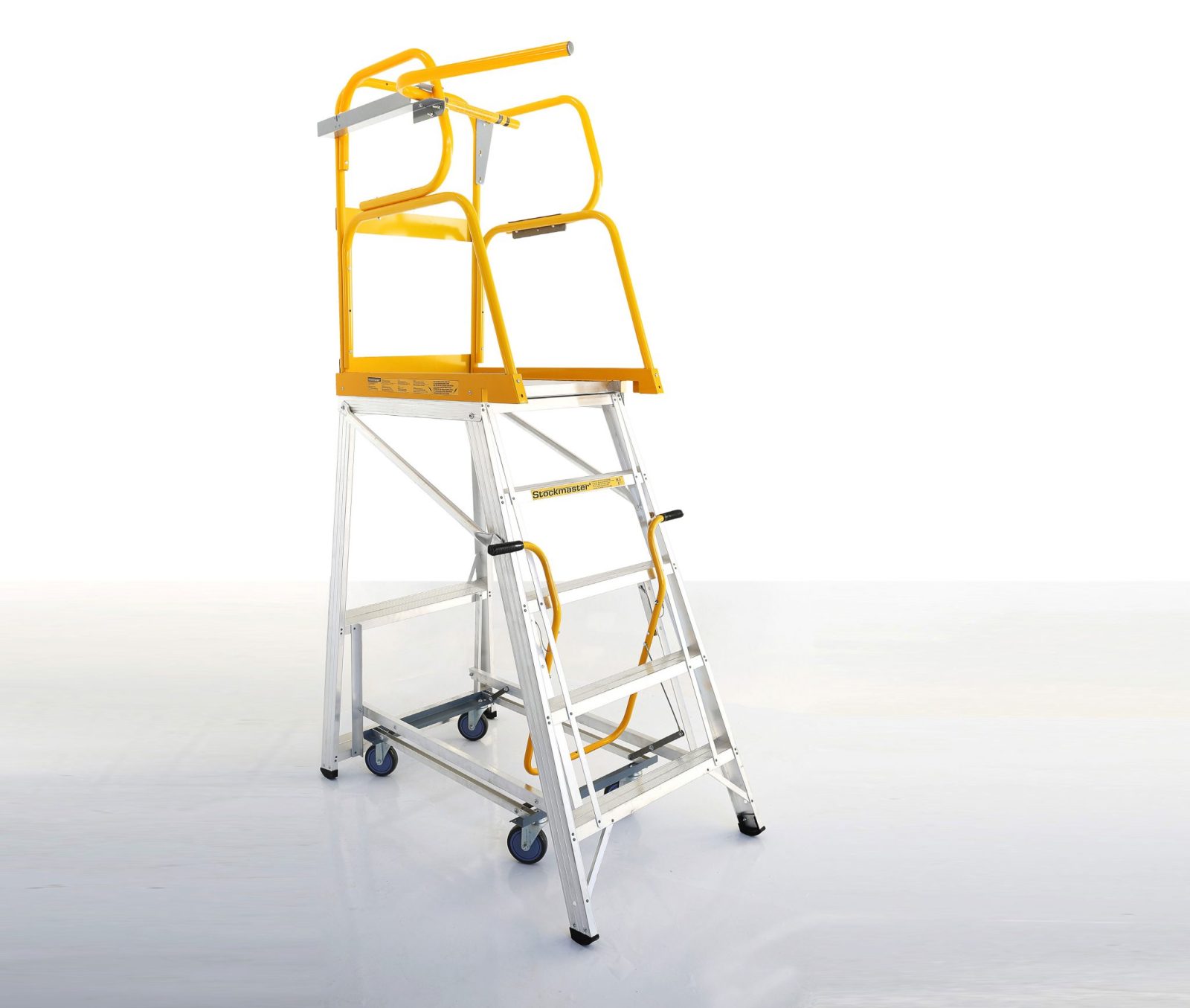
This is where a purpose-designed mobile platform ladder such as the StockMaster Navigator can provide a practical alternative to a conventional step ladder and serve as a suitable Warehouse Access Safety Ladder for appropriate applications.
Designed specifically for warehouse environments, the StockMaster Navigator combines a mobile access platform with a single-control braking and steering system. When stationary, all four feet remain firmly on the ground. When the operator takes hold of the control, the ladder moves into its mobile position for relocation. Releasing the control automatically returns it to its stationary, braked position.
For warehouses where workers repeatedly move between shelving locations, this approach can make a Warehouse Access Safety Ladder a more integrated part of the picking and stocking process.
What Is a Warehouse Access Safety Ladder?
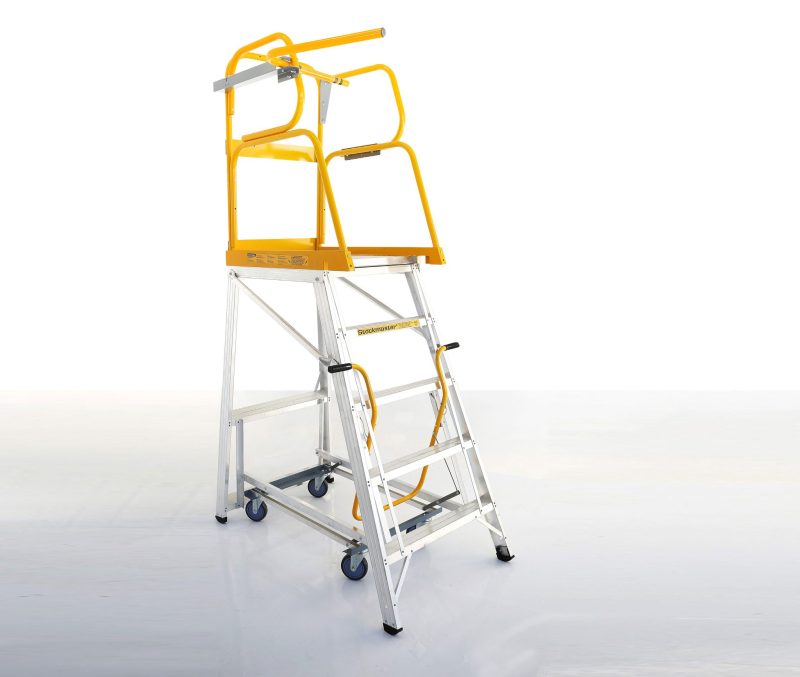
A Warehouse Access Safety Ladder is access equipment designed to help workers safely reach elevated storage, shelving, equipment or work areas within a warehouse or industrial environment.
The term does not necessarily refer to one specific ladder design. Different warehouse applications require different types of access equipment, so choosing the right Warehouse Access Safety Ladder depends on the specific task and working environment.
A small step ladder may be appropriate when a worker needs occasional access to a relatively low height. A mobile platform ladder may be more appropriate when employees need to repeatedly access elevated shelving, move between picking locations and work from a stable platform.
The important consideration is therefore not simply whether a ladder can reach the required height.
It is whether the Warehouse Access Safety Ladder is appropriate for the complete task.
For repetitive warehouse operations, factors such as repositioning, stability, working space, platform height and the type of items being handled can have a significant impact on the suitability of the equipment.
When Is a Platform Ladder Better Than a Step Ladder?
A platform ladder can be particularly useful when the work involves frequent access to elevated shelving or storage locations.
Consider a warehouse employee who needs to pick products from different shelf levels throughout a shift. With a conventional step ladder, the worker may need to repeatedly move and reposition the ladder as they progress through an aisle.
That may be manageable for occasional access.
However, when the same process is repeated dozens or hundreds of times, the access equipment becomes part of the overall workflow.
A mobile platform ladder is designed around this type of repetitive movement and can serve as a practical Warehouse Access Safety Ladder for suitable applications.
The StockMaster Navigator is specifically designed for applications including picking and shelf stocking. Its manoeuvrability allows it to be repositioned between fixtures, while its single control operates both steering and braking.
This makes the Navigator particularly relevant when a warehouse needs a Warehouse Access Safety Ladder that can move with the picking task rather than remaining in one location.
For repetitive warehouse access, selecting the right Warehouse Access Safety Ladder can help ensure the equipment is suited to the frequency and requirements of the task.
1. Repetitive Stock Picking
One of the clearest applications for the StockMaster Navigator is repetitive stock picking.
Warehouses often use vertical storage to maximise available floor space. Products may be stored across several levels, requiring employees to access shelves above normal standing reach.
When elevated access is required only occasionally, a conventional ladder may be sufficient.
But repetitive picking introduces different requirements.
A worker may need to:
- Move between multiple storage locations
- Reach products at different shelf heights
- Retrieve lightweight items
- Reposition the access equipment repeatedly
- Enter and leave the elevated working area throughout the task
- Complete these movements efficiently during a normal shift
The Navigator is designed around this type of application.
Its single-control system allows the operator to raise the unit into mobile mode and steer it to another position. Once the control is released, the ladder returns automatically to stationary mode, where it is braked and stable.
This provides a clear distinction between moving the ladder and working from the ladder.
2. Stability When the Ladder Is Stationary
Stability is one of the key considerations when selecting a warehouse access ladder.
The StockMaster Navigator is designed so that all four feet remain firmly on the ground while the unit is stationary. The ladder is raised into its mobile position only when the operator takes hold of the control.
This operating principle is particularly relevant in warehouse environments where the ladder may be moved frequently.
Rather than relying on the operator to manually transition between a mobile and stationary configuration, the Navigator’s control system manages the transition.
When the operator releases the control, the unit automatically returns to its stationary mode.
For a warehouse looking at Warehouse Access Safety Ladder options, this is an important feature to consider because access equipment needs to provide controlled movement as well as a stable working position.
3. Faster Repositioning Between Shelves
Warehouse productivity is influenced by many small movements.
If a worker needs to retrieve products from several locations, time can be spent not only picking the product but also positioning access equipment.
A difficult-to-move ladder can introduce additional handling into the process.
The StockMaster Navigator is designed to be highly manoeuvrable and suitable for confined spaces. Spacepac states that the Navigator can be moved to a new position in less than half the time of competing products, according to its product information.
For businesses with repetitive picking operations, easier repositioning can help make access equipment less disruptive to the workflow.
For example, a worker might move along a warehouse aisle and require elevated access at several points.
Instead of treating each elevated pick as a separate setup process, a mobile platform ladder can move with the worker as the picking route progresses.
The objective is not simply to make the ladder faster.
It is to make the overall access process more integrated with the warehouse workflow.
4. A Defined Working Platform
Another important difference between a step ladder and a platform ladder is the working position.
A platform ladder provides a dedicated platform on which the worker can stand while carrying out the task.
This can be useful for applications where the worker needs to remain at an elevated position long enough to retrieve, inspect or stock products.
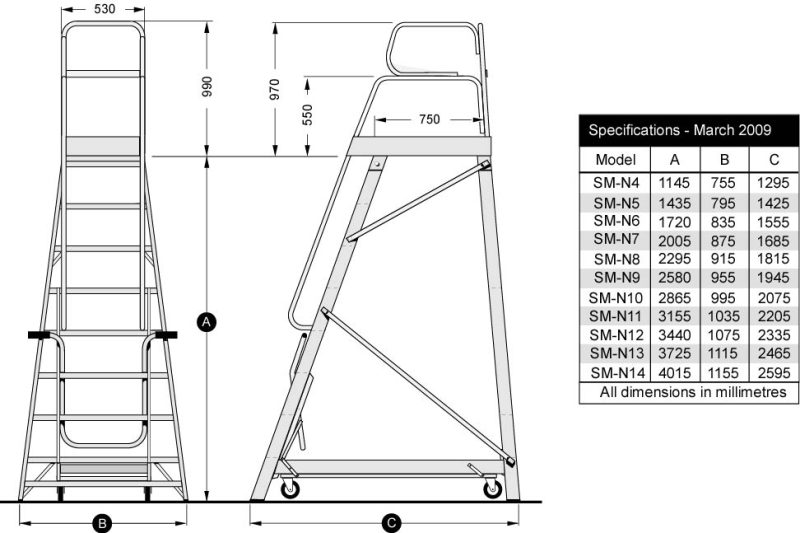
The StockMaster Navigator is available in multiple platform heights, allowing businesses to select a configuration according to the required working range.
Models range from the SM-N04, with a platform height of 1,145 mm, through to the SM-N14, with a platform height of 4,015 mm. Spacepac lists working ranges extending up to approximately 5.7 metres for the largest model when handling loads up to 5 kg.
The working range should not, however, be treated as the only factor when selecting a model.
The warehouse environment and actual application must also be assessed.
5. Designed for Warehouse Picking and Shelf Stocking
The StockMaster Navigator is not simply a general-purpose ladder adapted for warehouse use.
Its product information specifically identifies picking and shelf stocking as principal applications.
This distinction is important when selecting a Warehouse Access Safety Ladder.
Access equipment should be matched to the task it is expected to perform.
For example, a warehouse may have different requirements for:
- Picking lightweight products from shelving
- Maintenance and inspection
- Accessing trucks or containers
- Working on uneven outdoor surfaces
- Accessing mezzanine levels
- Handling heavier products
The Navigator is particularly suited to smooth, level warehouse floors and confined spaces. For poor operating surfaces, Spacepac identifies the StockMaster Tracker as an alternative depending on the available operating space.
This highlights an important principle: the right ladder depends on the application and environment.
6. The Warehouse Floor Needs to Be Considered
A common mistake when selecting warehouse access equipment is to focus only on the required working height.
The floor surface is equally important.
The StockMaster Navigator requires a smooth and level operating surface. Spacepac states that, in mobile mode, its feet clear the operating surface by approximately 20 mm. Typical concrete slab flooring can be suitable, while areas around drains, sumps or other variations exceeding this clearance may prevent correct operation.
Before purchasing a Navigator, businesses should therefore assess the areas in which it will operate.
Consider:
- Floor condition
- Changes in floor level
- Drainage channels
- Sumps
- Ramps
- Uneven surfaces
- Transitions between different floor areas
If the warehouse contains significant changes in floor level or requires access across sealed and unsealed surfaces, another StockMaster configuration may be more suitable.
7. Confined Warehouse Spaces
Warehouse aisles can become increasingly difficult to navigate as storage systems, pallets, machinery and other equipment occupy available floor space.
A mobile access platform therefore needs to be compatible with the warehouse layout.
The StockMaster Navigator is designed for manoeuvrability and is suitable for confined spaces. However, Spacepac recommends checking the available operating space before selecting the product.
Important considerations include:
Aisle width
Is there sufficient room to move the ladder between shelving and other equipment?
Turning space
Can the ladder be repositioned effectively at the end of an aisle?
Overhead clearance
Are doorways, beams, lighting and other overhead structures high enough for the selected model?
Storage layout
Can the Navigator move between service aisles and picking aisles without obstruction?
Equipment clearance
Is sufficient space available around forklifts, conveyors, machinery and other fixtures?
These factors should form part of the selection process before introducing a mobile platform ladder into the warehouse.
Navigator vs a Conventional Step Ladder
The choice between a platform ladder and a step ladder should ultimately depend on the application.
| Consideration | Conventional Step Ladder | StockMaster Navigator |
|---|---|---|
| Occasional low-level access | Suitable for some applications | Suitable where a mobile platform is required |
| Repetitive stock picking | May require frequent repositioning | Designed for picking and shelf stocking |
| Elevated working platform | Limited depending on design | Dedicated platform |
| Warehouse mobility | Depends on ladder design | Single control for steering and braking |
| Stationary stability | Depends on design and setup | Four feet remain firmly on ground when stationary |
| Confined warehouse spaces | Depends on model | Designed for manoeuvrability |
| Multiple platform heights | Depends on model | Multiple Navigator sizes available |
| Warehouse picking workflow | General access equipment | Specifically designed for picking and shelf stocking |
This comparison does not mean that a platform ladder should replace every step ladder.
For occasional, short-duration tasks, a conventional ladder may still be appropriate.
The Navigator becomes particularly relevant when elevated access is a regular part of the warehouse workflow.
Navigator Pro: Additional Features for Picking Applications
For warehouses requiring additional protection around the platform, the StockMaster Navigator Pro adds several features.
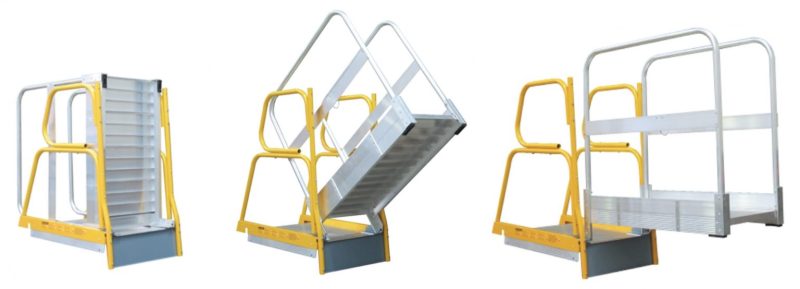
Navigator Pro includes an adjustable safety railing system and an automatic closing gate at the platform entry. The Auto-Gate is designed to provide protection against accidentally stepping off the front of the platform.
The Navigator Pro also incorporates the StockMaster Rota-Gate.
This provides side access to the platform and can be useful for stock picking, inspection and similar tasks.
These features can be particularly relevant in warehouse applications where employees regularly enter and exit the elevated working area.
The Auto-Gate is also available as an accessory for compatible StockMaster Navigator, Tracker and Lift-Truk models manufactured after 2008, subject to compatibility requirements.
Load Requirements Are Also Important
Selecting a ladder based only on its maximum load rating can be misleading.
The StockMaster Navigator is designed and tested to a 150 kg load rating, but the type and weight of items being handled also need to be considered.
For picking and shelf-stocking applications, Spacepac recommends that items handled should generally be lightweight, up to 5 kg, and capable of being carried in one hand.
For larger or heavier items, a dedicated material-handling solution may be more appropriate.
This is an important part of warehouse access safety.
A platform ladder provides access. It should not automatically be treated as a lifting device for heavy products.
Businesses should assess whether the worker can safely handle the product from the selected working position and whether additional lifting equipment is required.
When a Different StockMaster Product May Be More Suitable
The Navigator is a strong option for smooth, level warehouse floors and picking applications, but it is not designed for every environment.
For example, the StockMaster Tracker is designed for indoor and outdoor applications and can move over sealed or unsealed surfaces and slopes.
The StockMaster Step-Thru serves a different purpose, providing mobile access for applications such as trucks, containers and mezzanine floors. It is designed with a stable stepping platform and side safety rails.
This demonstrates why businesses should avoid choosing access equipment based solely on the ladder’s height or appearance.
The best solution depends on:
- The operating surface
- The required working height
- The application
- The weight of materials being handled
- The frequency of access
- The available working space
- Whether the equipment needs to be moved indoors or outdoors
Australian, New Zealand, US and European Standards
The StockMaster Navigator product information states that it meets or exceeds the requirements of AS/NZS 1892.1:1996, ANSI-ASC A14.2-2007 and EN 131 Parts 1 and 2. It is also designed and tested to a 150 kg load rating.
Standards compliance is one consideration when selecting workplace access equipment.
However, compliance alone does not determine whether a particular ladder is suitable for a specific warehouse.
The employer or site operator should also consider the actual task, work environment, worker requirements, product loads, floor condition and warehouse layout.
The objective should be to select equipment that is appropriate for the complete work activity.
How to Select a Warehouse Access Safety Ladder
Before selecting a Warehouse Access Safety Ladder, ask the following questions:
1. How high do workers need to reach?
Determine the actual working height rather than selecting a ladder based only on platform height.
2. How frequently will the ladder be used?
Occasional access and repetitive stock picking can require very different equipment.
3. Does the ladder need to be moved frequently?
If workers regularly move between picking locations, a mobile platform can provide operational advantages.
4. What is the warehouse floor like?
The Navigator is intended for smooth, level surfaces. Uneven or outdoor applications may require another StockMaster model.
5. What products are being handled?
Lightweight, one-handed items are particularly relevant to Navigator picking applications. Heavy products may require additional lifting equipment.
6. How much space is available?
Check aisle widths, turning areas, overhead clearance and obstacles before selecting the model.
7. Is additional platform protection required?
For applications where workers frequently enter and leave the elevated workspace, Navigator Pro features such as the Auto-Gate and Rota-Gate may be worth considering.
Conclusion: Choosing Access Equipment for the Actual Warehouse Task
A step ladder can be useful for many basic access tasks, but repetitive warehouse picking can create different requirements.
When workers regularly need to access elevated shelving, move between storage locations and work from an elevated position, a purpose-designed mobile platform ladder can provide features that are specifically suited to the workflow.
The StockMaster Navigator is designed for picking and shelf-stocking applications on smooth, level warehouse floors. Its single-control steering and braking system, four-foot stationary configuration, manoeuvrability and range of platform heights make it a practical Warehouse Access Safety Ladder option for warehouses requiring frequent elevated access.
For additional platform protection, the Navigator Pro adds an adjustable safety rail, automatic closing gate and Rota-Gate for side access.
The most important consideration is not whether a platform ladder is universally better than a step ladder.
It is whether the access equipment is appropriate for the task, environment and frequency of use. Choosing the right Warehouse Access Safety Ladder can help ensure the access solution is suited to the specific warehouse application.
For warehouses where elevated stock picking is a routine activity, the StockMaster Navigator provides a purpose-designed approach to mobile warehouse access and is a practical Warehouse Access Safety Ladder for suitable applications.
To determine which Navigator model is appropriate for your warehouse, consider the required working range, floor conditions, aisle dimensions, product weight and operating environment.
For more information about the StockMaster Navigator and warehouse access solutions, contact Spacepac on 1300 763 444 or visit the StockMaster Navigator product page.